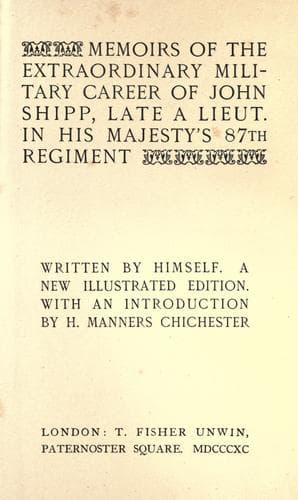
Memoirs of the Extraordinary Military Career of John Shipp: Late a Lieut. in His Majesty's 87th RegimentShipp, John
History
Memoirs of the Extraordinary Military Career of John Shipp: Late a Lieut. in His Majesty's 87th Regiment
Shipp, John
India -- History -- British occupation, 1765-1947 -- Biography; Shipp, John, 1784-1834
before, had fought hard in the bitterest rancour of their souls, now
interchanging the most affectionate civilities.
I have, in the hurry of my narrative, forgotten a circumstance which
reflects honour on the soldier whom it concerns. When on the top of the
hill where the action raged most, one of the enemy showed himself most
conspicuously, fighting like a hero. He had just shot one of our men
close by where I stood, when I made towards him, with a man of the name
of Quanbury. Finding that he was receding from us, and again loading,
the soldier next me fired, and the man fell upon his knees. Quanbury
immediately ran up to him--for he still grasped his firelock--and was in
the act of running him through, when the man threw down his arms. Seeing
this, the brave Irish soldier stayed his finishing blow, exclaiming, "By
the powers, my fine fellow, but it was well you were after doing that
self-same thing; for had you shot me as you did that other man, bad luck
to me if I wouldn't have blown your brains out; so I would." Here the
quarter-master-general came up and took charge of his prisoner, and we
passed on to clear the hill of others who were keeping up a heavy fire.
[Illustration]
CHAPTER XIV.
We were still obliged to carry on our approaches with all possible
vigilance and activity; and our discipline was not relaxed in the
slightest particular. We were compelled to watch the enemy with a
jealous eye, not allowing our late little victory to feed our vanity, or
to seduce us from our wonted caution. Every eye was now fixed on the
hill which was in front of our head approach; and various and ludicrous
were the reports and opinions, during the day and night, of the
movements on the said hill. Fallen trees were magnified into guns and
mortars; variegated bushes into soldiers; the light between the trees
into flags; and the midnight _ignis fatuus_, on its nocturnal rambles,
into torches and lights of the enemy. The rustling leaves, falling down
the wintry glen, were construed into the coming foe; and, had one of our
captains been the commander-in-chief, the hill would have been treeless
and leafless, for he would have blown them all up instead of the enemy.
The glass was never from this gentleman's eye. Could his thoughts and
speculations by day and night have been committed to paper, his words
would have shone forth in all the radiance of a military vocabulary.
What shells would he not have expended upon the poor _ignis fatuus_! All
we could do or say, he would not believe us. If he had been our general,
we should have been in Khatmandoo, the capital of Nepaul, in half the
time. His system was new and wonderful; for, when arguing on the best
plan to be adopted, he had always the most happy knack of catching the
enemy asleep. But in these notions he happened to have mistaken his men.
The Nepaulese soldiers never sleep, or rather, such is their
watchfulness, that you can never surprise them. This misconception of
Public-domain text, read in full here on John Shaqi.
Reviews
Reviews
No reviews yet
Be the first to share your thoughts on this work.
Elsewhere in the archive
Join the Discussion
Join the discussion
Sign in to leave a comment or review.
Sign InorCreate an account