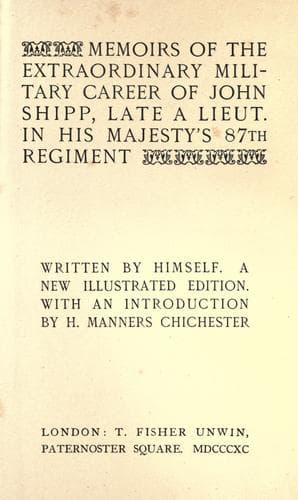
Memoirs of the Extraordinary Military Career of John Shipp: Late a Lieut. in His Majesty's 87th RegimentShipp, John
History
Memoirs of the Extraordinary Military Career of John Shipp: Late a Lieut. in His Majesty's 87th Regiment
Shipp, John
India -- History -- British occupation, 1765-1947 -- Biography; Shipp, John, 1784-1834
Shipp's father was a soldier (a marine?), and his mother dying when he
was very young, he became an inmate of the parish poorhouse (there were
no Union workhouses in those days), whence he passed into the hands of a
neighbouring farmer, one of those savage taskmasters only too common in
the "good old times."[1] His deliverance came in unexpected fashion. In
the early years of the French Revolutionary War the supply of recruits
was far less certain than at a later stage. Partly as a recruiting
experiment, partly to relieve parishes of the burthen of pauper boys
between the ages of ten and sixteen who might be willing to enter for
(_un_limited) service in the army, three regiments of foot were ordered
to be completed to a thousand rank and file each by the enlisting of
boys of this description. One of the regiments was the 22nd (Cheshire)
Regiment of Foot, which half a century later won much fame under the
command of General Sir Charles Napier on the plains of Sind. The 22nd,
on return from the West Indies in 1795, had been ordered to Colchester,
to recruit; and a Muster Roll, now in the War Office, shows that John
Shipp was duly enlisted into that regiment on January 17, 1797.
Shipp appears to have been a bright, plucky, intelligent boy. Regimental
schools were not in those days; but through the kindness of his captain
he picked up some education, and after serving in the Channel Islands,
at the Cape, and in India, found himself, in the year 1804, a young
sergeant in the Grenadier company, which was detached with the grand
army under Lord Lake fighting against the Mahrattas. He was one of the
stormers at the capture of Deig, on December 24, 1804, and led the
"forlorn-hope" of the storming column in _three_ out of the four
desperate, but unsuccessful, assaults on Bhurtpore in January-February,
1805, receiving severe wounds upon each occasion. Lord Lake rewarded his
daring with an ensigncy in the 65th Foot. A few weeks later he was
promoted to lieutenant in the 76th Foot, both commissions being dated
March 10, 1805. With the 76th Shipp returned home in 1807; but he
speedily found himself in pecuniary difficulties, and sold out of the
army on March 19, 1808. His commissions having been given "without
purchase," he was only entitled to L100 for each twelve months of actual
commissioned service abroad, and L50 for like periods at home, up to the
full value--L700. With the small sum so realized he paid his debts, and
soon after found himself alone in London, without a shilling in the
world.
Public-domain text, read in full here on John Shaqi.
Reviews
Reviews
No reviews yet
Be the first to share your thoughts on this work.
Join the Discussion
Join the discussion
Sign in to leave a comment or review.
Sign InorCreate an account