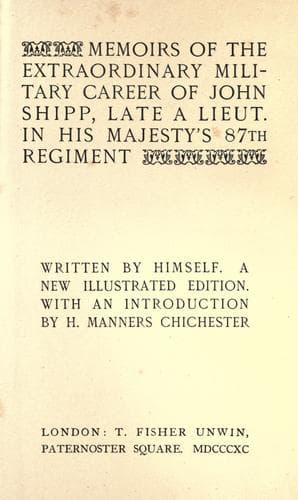
Memoirs of the Extraordinary Military Career of John Shipp: Late a Lieut. in His Majesty's 87th Regiment — John Shaqi
Memoirs of the Extraordinary Military Career of John Shipp: Late a Lieut. in His Majesty's 87th RegimentShipp, John
History
Memoirs of the Extraordinary Military Career of John Shipp: Late a Lieut. in His Majesty's 87th Regiment
Shipp, John
India -- History -- British occupation, 1765-1947 -- Biography; Shipp, John, 1784-1834
Having continued on this duty for upwards of two years, to very little
purpose, the Cape of Good Hope was ordered, by the British Government,
in 1801, to be given up to the Dutch. To remove the rifle company, and
the light company of the 91st Foot, a small vessel was dispatched from
Cape Town to Algoa Bay, for their conveyance to the capital, preparatory
to embarking for India. I was dispatched over land with a Dutch boer's
family, then about to leave the station for Cape Town. The whole of the
officers' baggage was committed to my care, which was a very serious
charge and responsibility, through such a wild and desolate country. On
this trip I had to pass along the margin of the country inhabited by the
Caffres; and, although the Dutch family with whom I travelled had
muskets and four waggons, these sojourners in the woods and hills
neither feared them nor their guns. After laying in a good stock of
powder and shot, we commenced our march in regular battle array. I was
mounted on a horse, with my rifle slung over my back, always loaded, and
a pistol in my holster-pipe; on each side rode the Dutchman's two sons;
after us, four Hottentots, armed with muskets; then the old boss (the
master); and, following him, the four waggons, containing the families
and property of all. The rear-guard consisted of two head servants
(Hottentots) armed, on bullocks; then four on foot, with their families,
many of the women carrying two children. Thus we would accomplish twenty
miles a day over the most enormous hills; and, if we could not reach a
farmhouse by the setting sun, which was the time we generally halted, we
selected the most open spot we could find for our encampment, forming a
square with the four waggons, keeping our cattle inside, where they were
fed. Six men out of the twelve kept watch the whole night, and were
relieved every four hours, in which duty I always took a part. In fact,
we were so often disturbed, either by the Caffres, or some beast of prey
prowling about our little fortified encampment, that we might be said to
be always watching. The Caffre possesses a great deal of cunning and
craft. Their system of attack is this: under the garb of night, when all
is still save the roaring lion, the hungry tiger, or the screeching owl,
they will crawl on their hands and knees, imitating the cries of any
animal of the woods, or any bird of the air. At the smallest noise they
will turn themselves flat on the ground, so that you may walk close by,
and not observe them; and the first indication given you of having such
dangerous neighbours, is by the incision of a spear, or the blow of a
club. These imitations of the cries of animals, and chirping of birds,
are well understood amongst themselves. No wonder, then, that we should
watch. It was no unusual thing in the morning to see their spears lodged
in the top of our waggons, and close by where we kept watch; but we
never attempted to leave our possessions, and resolved not to throw away
Public-domain text, read in full here on John Shaqi.
Reviews
Reviews
No reviews yet
Be the first to share your thoughts on this work.
Join the Discussion
Join the discussion
Sign in to leave a comment or review.
Sign InorCreate an account