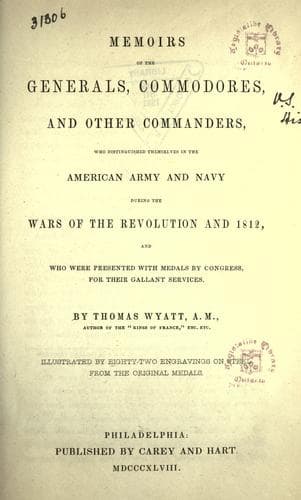
Memoirs of the Generals, Commodores and other Commanders, who distinguished themselves in the American army and navy during the wars of the Revolution and 1812, and who were presented with medals by Congress for their gallant servicesWyatt, Thomas
History
Memoirs of the Generals, Commodores and other Commanders, who distinguished themselves in the American army and navy during the wars of the Revolution and 1812, and who were presented with medals by Congress for their gallant services
Wyatt, Thomas
United States -- History -- Revolution, 1775-1783 -- Biography; United States -- History -- Revolution, 1775-1783 -- Medals; United States -- History -- War of 1812 -- Biography; United States -- History -- War of 1812 -- Medals
It was his intention to fortify West Point, and the Highlands of the
North River; accordingly the works at Stony and Verplanck’s Points were
commenced for that purpose, yet only on Verplanck’s a small but strong
work had been completed and garrisoned by seventy men, under Captain
Armstrong, while the works on Stony Point, of much greater extent and
of incomparably more importance, were unfinished. To secure these
valuable positions was a matter of great magnitude both to the British
as well as American commander-in-chief; hence was the determination of
fortifying the Highlands, so as to comprehend within it these important
positions. To arrest the progress of these fortifications, Sir Henry
Clinton sailed with a fleet up the Hudson, and landed his troops in
two divisions; the one under General Vaughan, destined against the
works at Verplanck’s on the east side of the river--the other, which he
commanded in person, against those of Stony Point, on the west side.
The fortifications on Stony Point being unfinished, were abandoned
without resistance, on the approach of the enemy, who instantly
commenced dragging some heavy cannon and mortars to the summit of the
hill, and on the next morning about sunrise opened a battery on Fort
Fayette, erected on Verplanck’s, the distance across being about one
thousand yards.
The cannonade during the day, from the very commanding position
of Stony Point, as also from vessels and gun-boats in the river,
occasioned much injury to the fort; which, being invested both by water
and land, and no means of saving the garrison now remaining, Captain
Armstrong, (who had command,) after a gallant resistance, was compelled
to surrender himself and troops prisoners of war. Sir Henry proceeded
immediately to place both forts in what he supposed a perfect state
of defence, especially that of Stony Point, which he garrisoned with
six hundred men, under the command of an officer distinguished for his
bravery and circumspection. In consequence of Washington being now at
West Point, Sir Henry declined a further movement up the Hudson, but
remained with his army at Phillipsburg, about midway between New York
and Stony Point. Immediately on the arrival of Wayne at head quarters,
Washington commenced laying plans for the recapture of Stony Point, and
in a conference between the commander-in-chief and Wayne, the latter,
emphatically to express his willingness to undertake the perilous
enterprise, is said to have remarked:--“General, if _you_ will only
plan it, I will storm _Hell_!”
Reviews
Reviews
No reviews yet
Be the first to share your thoughts on this work.
Join the Discussion
Join the discussion
Sign in to leave a comment or review.
Sign InorCreate an account