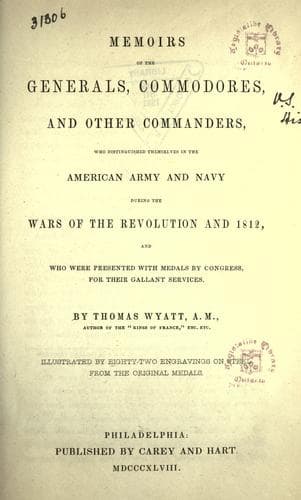
Memoirs of the Generals, Commodores and other Commanders, who distinguished themselves in the American army and navy during the wars of the Revolution and 1812, and who were presented with medals by Congress for their gallant servicesWyatt, Thomas
History
Memoirs of the Generals, Commodores and other Commanders, who distinguished themselves in the American army and navy during the wars of the Revolution and 1812, and who were presented with medals by Congress for their gallant services
Wyatt, Thomas
United States -- History -- Revolution, 1775-1783 -- Biography; United States -- History -- Revolution, 1775-1783 -- Medals; United States -- History -- War of 1812 -- Biography; United States -- History -- War of 1812 -- Medals
The general, in his official papers, says, “that neither the deep
morass, the formidable and double rows of _abatis_, or the strong works
in front and flank could damp the ardor of his brave troops; who, in
the face of a most incessant and tremendous fire of musketry, and of
cannon loaded with grape-shot, forced their way at the point of the
bayonet through every obstacle, until the van of each column met in
the centre of the works, where they arrived at nearly the same time.”
General Wayne was wounded in the head by a musket-ball, as he passed
the last _abatis_; but was gallantly supported and assisted through the
works by his two brave aids-de-camp, Fishbourn and Archer, to whom he
acknowledges the utmost gratitude in his public letter. Colonel Fleury,
a French officer, had the honor of striking the British standard with
his own hand, and placing in its room the American stars and stripes.
Major Stewart and several other officers received great praise;
particularly the two Lieutenants Gibbons and Knox, one of whom led the
avant-guard on the right, and the other on the left. Both, however, had
the good fortune to escape unhurt, although Lieutenant Gibbons lost
seventeen men out of twenty in the attack.
There is nothing in the annals of war which affords more room for
surprise, and seems less to be accounted for, than the prodigious
disparity between the numbers slain in those different actions, which
seem otherwise similar or greatly to correspond in their principal
circumstances, nature and magnitude. Nothing could well be supposed,
from its nature and circumstances, more bloody, in proportion to the
numbers engaged, than this action; and yet the loss on both sides was
exceedingly moderate.
Nothing could exceed the triumph of America and Americans generally,
upon the success of this enterprize, and the vigor and spirit with
which it was conducted.
It must, indeed, be acknowledged, that considered in all its parts
and difficulties, it would have done honor to the most veteran
soldiers. General Washington, the Congress, the General Assembly, and
the Supreme Executive Council of Pennsylvania, were emulous in their
acknowledgments, and in the praises which they bestowed upon General
Wayne, his officers and troops. In these they particularly applaud
the humanity and clemency shown to the vanquished, when, by the laws
of war, and stimulated by resentment from the remembrance of former
cruelty received from the British, they would have been justified in
putting the whole garrison to the sword.
Reviews
Reviews
No reviews yet
Be the first to share your thoughts on this work.
Join the Discussion
Join the discussion
Sign in to leave a comment or review.
Sign InorCreate an account