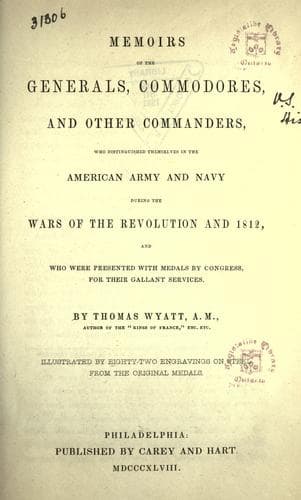
Memoirs of the Generals, Commodores and other Commanders, who distinguished themselves in the American army and navy during the wars of the Revolution and 1812, and who were presented with medals by Congress for their gallant servicesWyatt, Thomas
History
Memoirs of the Generals, Commodores and other Commanders, who distinguished themselves in the American army and navy during the wars of the Revolution and 1812, and who were presented with medals by Congress for their gallant services
Wyatt, Thomas
United States -- History -- Revolution, 1775-1783 -- Biography; United States -- History -- Revolution, 1775-1783 -- Medals; United States -- History -- War of 1812 -- Biography; United States -- History -- War of 1812 -- Medals
In a letter from General Washington to Wayne, he adds:--“The Marquis
Lafayette speaks in the handsomest manner of your own behavior, and
that of the troops, in the action at Green Spring. I think the account
which Lord Cornwallis will be obliged to render of the state of
southern affairs, will not be very pleasing to ministerial eyes and
ears, especially after what appears to have been their expectations by
their intercepted letters of March last. I am in hopes that Virginia
will be soon, if not before this time, so far relieved as to permit
you to march to the succor of General Greene, who, with a handful of
men, has done more than could possibly have been expected; should he
be enabled to maintain his advantage in the Carolinas and Georgia, it
cannot fail of having the most important political consequences in
Europe.” The movements of Cornwallis indicated a permanent post at
Yorktown, a short distance up the York river, where he had removed
the principal part of his forces, and commenced his fortifications.
Washington hearing of this movement, commanded Lafayette to take early
measures to intercept the retreat of Cornwallis, should he discover the
intended blow, and attempt a retreat by North Carolina.
At the interposition of the Marquis Lafayette with his government,
a French fleet, consisting of three thousand troops, were equipped
and dispatched to the assistance of struggling America; and on the
2d September landed at Burwell’s Ferry, near this place. Lafayette,
who was encamped about ten miles from General Wayne, on hearing of
the arrival of the French fleet, requested an interview with him. In
a letter to a friend, Wayne describes an accident that occurred to
him on his way thither:--“After the landing of the French fleet, and
pointing out to them the most proper position for their encampment, I
received an express from the Marquis Lafayette, to meet him on business
of importance that evening. I proceeded accordingly, attended by two
gentlemen and a servant. When we arrived in the vicinity of the camp,
about ten o’clock at night, we were challenged by a sentry, and we made
the usual answer, but the poor fellow being panic-struck, mistook us
for the enemy, and shot me in the centre of the left thigh; then fled
and alarmed the camp. Fortunately, the ball only grazed the bone, and
lodged on the opposite side to which it entered.” The main works of
Cornwallis were at his strongly fortified garrison at Yorktown, on the
York river. He also occupied Gloucester, on the opposite side, where he
erected works to keep up the communication with the country. General
Washington reached the neighborhood of this interesting scene of
operation on the 14th of September, and immediately proceeded on board
the Ville de Paris, (flag-ship of the French admiral,) where the plan
of the siege was concerted.
Subjoined is an extract of General Wayne’s diary of the siege of
Yorktown and capture of Lord Cornwallis:
Public-domain text, read in full here on John Shaqi.
Reviews
Reviews
No reviews yet
Be the first to share your thoughts on this work.
Join the Discussion
Join the discussion
Sign in to leave a comment or review.
Sign InorCreate an account