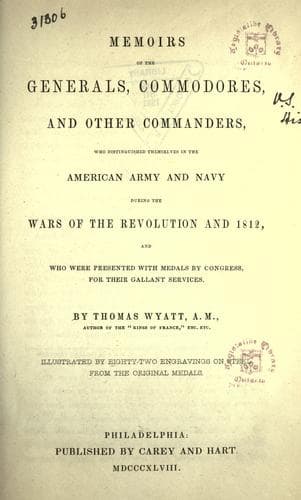
Memoirs of the Generals, Commodores and other Commanders, who distinguished themselves in the American army and navy during the wars of the Revolution and 1812, and who were presented with medals by Congress for their gallant servicesWyatt, Thomas
History
Memoirs of the Generals, Commodores and other Commanders, who distinguished themselves in the American army and navy during the wars of the Revolution and 1812, and who were presented with medals by Congress for their gallant services
Wyatt, Thomas
United States -- History -- Revolution, 1775-1783 -- Biography; United States -- History -- Revolution, 1775-1783 -- Medals; United States -- History -- War of 1812 -- Biography; United States -- History -- War of 1812 -- Medals
“Our army lost, in killed and wounded, forty-one. The other was
carried by the French, under the Baron de Viominial, who lost, in
killed and wounded, about one hundred men. Of the enemy eighteen
were killed, and three officers and thirty-nine privates were made
prisoners. The above attacks were supported by two battalions of the
Pennsylvanians, under General Wayne; whilst the second parallel was
completed by the Pennsylvanians and Marylanders, under Colonel W.
Stewart.
“15th. Two small batteries were opened this evening.
“16th. The enemy made a sortie, and spiked seven pieces of artillery,
but were immediately repulsed, the spikes drawn, and the batteries
again opened.
“17th. The enemy beat the chamade at ten o’clock A. M., Cornwallis now
sent out a flag, proposing a cessation of hostilities for twenty-four
hours, and that commissioners might be appointed to meet to settle the
terms upon which the garrisons of York and Gloucester should surrender.
General Washington would only grant a cessation for _two hours_;
previously to the expiration of which, his lordship, by another flag,
sent the following terms, viz:--The troops to be prisoners of war; the
British to be sent to Great Britain, and not to act against America,
France, or her allies, until exchanged; the Hessians to Germany, on the
same conditions; and that all operations cease until the commissioners
should determine the details. To this his excellency returned for
answer:--That hostilities should cease, and no alterations in the
works, or any new movement of the troops, take place, until he sent
terms in writing; which he did on the 18th, at nine o’clock, A. M.,
allowing the enemy two hours to determine. They again requested more
time; and the general granted them until one o’clock, when they acceded
to the heads of the imposed terms, and nominated Colonel Dundas and
Major Ross, on their part, to meet with Colonel Laurens and Viscount
de Noailles on ours, to reduce them to form, which was completed by
nine o’clock at night; and on the 19th, at one o’clock P. M., the
capitulation was ratified and signed by the commander of each army,
when the enemy received a guard of Pennsylvania and Maryland troops in
one of their principal works, and one of the French troops in another.
At four o’clock, the same afternoon, the British army marched out of
Yorktown with _colors cased_, between the American and French troops,
drawn up for the purpose, and then grounded their arms agreeably to
capitulation.”
Memoirs of the Generals, Commodores and other Commanders, who distinguished themselves in the American army and navy during the wars of the Revolution and 1812, and who were presented with medals by Congress for their gallant services — John Shaqi
Reviews
Reviews
No reviews yet
Be the first to share your thoughts on this work.
Join the Discussion
Join the discussion
Sign in to leave a comment or review.
Sign InorCreate an account