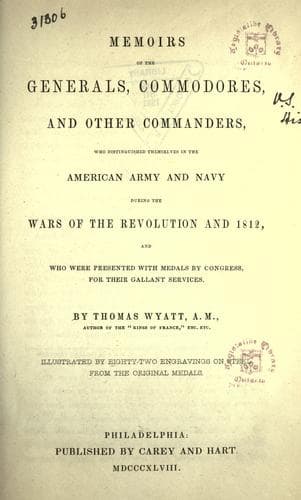
Memoirs of the Generals, Commodores and other Commanders, who distinguished themselves in the American army and navy during the wars of the Revolution and 1812, and who were presented with medals by Congress for their gallant servicesWyatt, Thomas
History
Memoirs of the Generals, Commodores and other Commanders, who distinguished themselves in the American army and navy during the wars of the Revolution and 1812, and who were presented with medals by Congress for their gallant services
Wyatt, Thomas
United States -- History -- Revolution, 1775-1783 -- Biography; United States -- History -- Revolution, 1775-1783 -- Medals; United States -- History -- War of 1812 -- Biography; United States -- History -- War of 1812 -- Medals
The father of Daniel Morgan was a Welshman, who had emigrated from
Wales, and settled in the state of New Jersey, some years before
the birth of his son, which took place in the year 1736. His father
was poor, consequently his education was confined to the ordinary
branches of a country school. At an early age, an enterprising
character appeared to be developing itself, and our hero, at the age of
seventeen, left the humble roof of his parents, to improve his fortune
at the south. Accordingly, we next find him as wagoner on the estate
of a wealthy planter, in Frederick county, Virginia. In the situation
of teamster, he continued until after the unfortunate expedition of
Braddock; during the whole of this campaign he drove his own team
attached to the army. During this unfortunate campaign he was charged
with insolence to a British officer, tried and sentenced to receive
five hundred lashes, which he submitted to with that firm indifference
which was peculiar to him through the remainder of his life. Lee, in
his memoirs says, “That in a few days after the infliction of this
disgraceful punishment, the officer became convinced of the injustice
of the charge, and made an ample atonement to young Morgan before the
whole regiment.” It was during this disastrous campaign, that the
military qualifications of Morgan were first noticed, when the officers
recommended him to the colonial government of Virginia, from which he
received a commission as ensign in the English service. It was in this
capacity that his powers of mind burst forth, in those qualifications
which twenty years afterwards distinguished him as one of the prominent
heroes of the glorious revolution.
Although engaged from 1775 to 1781, in which he saw more actual service
than any other American officer, he received but one dangerous wound.
He was attacked by a party of Indians, while carrying dispatches to
a frontier post, accompanied by two soldiers; he received a ball,
which entering the back of his neck, came out through his left cheek,
shattering his jaw in a dangerous manner. He was mounted on a fleet
horse, and in falling, grasped firmly the neck of the animal. The
savages, presuming he was dead, left him to scalp the two that had
fallen. Morgan, who believed that his wounds would prove fatal, or that
he should be exhausted by loss of blood, urged his horse to full speed,
and the noble animal escaped with him into the fort. One of the savages
followed him for some distance, as fast as he could run, with open
mouth and tomahawk in hand, expecting every moment his victim would
fall. When the disappointed savage found the horse was fast leaving him
behind, he threw his tomahawk with great force, but without effect, and
abandoned the pursuit with a most hideous yell.
Reviews
Reviews
No reviews yet
Be the first to share your thoughts on this work.
Join the Discussion
Join the discussion
Sign in to leave a comment or review.
Sign InorCreate an account