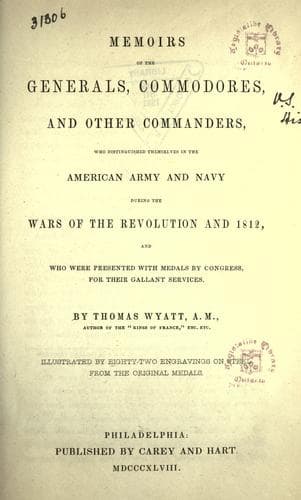
Memoirs of the Generals, Commodores and other Commanders, who distinguished themselves in the American army and navy during the wars of the Revolution and 1812, and who were presented with medals by Congress for their gallant services — John Shaqi
Memoirs of the Generals, Commodores and other Commanders, who distinguished themselves in the American army and navy during the wars of the Revolution and 1812, and who were presented with medals by Congress for their gallant servicesWyatt, Thomas
History
Memoirs of the Generals, Commodores and other Commanders, who distinguished themselves in the American army and navy during the wars of the Revolution and 1812, and who were presented with medals by Congress for their gallant services
Wyatt, Thomas
United States -- History -- Revolution, 1775-1783 -- Biography; United States -- History -- Revolution, 1775-1783 -- Medals; United States -- History -- War of 1812 -- Biography; United States -- History -- War of 1812 -- Medals
Kind Providence preserved him for great and nobler services. Soon
after this transaction, the regulation of rank, which had justly been
considered as a grievance by the colonial officers, was changed in
consequence of a spirited remonstrance of Washington; and the governor
of Virginia rewarded this brave young officer with the command of all
the troops of that colony. The troops under his command were gradually
inured in that most difficult kind of warfare called bush-fighting,
while the activity of the French and ferocity of the Indians were
overcome by his superior valor.
Washington received the most flattering marks of public approbation;
but his best reward was the consciousness of his own integrity.
In the course of this decisive campaign, which restored the
tranquillity and security of the middle colonies, Washington had
suffered many hardships which impaired his health. He was afflicted
with an inveterate pulmonary complaint, and extremely debilitated,
insomuch that, in the year 1759, he resigned his commission and retired
to Mount Vernon. By a due attention to regimen, in the quiet bowers of
Mount Vernon, he gradually recovered from his indisposition.
During the tedious period of his convalescence, the British troops had
been victorious; his country had no more occasion for the exertion of
his military talents. In 1761, he married the young widow of Colonel
Custis, who had left her sole executrix to his extensive possessions,
and guardian to his two children. The union of Washington with this
accomplished lady was productive of their mutual felicity; and as he
incessantly pursued agricultural improvements, his taste embellished
and enriched the fertile fields around Mount Vernon. But the time was
approaching when Washington was to relinquish the happiness of his home
to act a conspicuous part on the great theatre of the world.
For more than ten years had the colonies and their mother country
been at variance from causes of usurpation and tyranny, and the
awful moment was fast approaching when America was to throw off her
fetters and proclaim herself free. In 1775, Washington was elected
commander-in-chief of the whole American army. The American army were,
at the time of this appointment, entrenched on Winter Hill, Prospect
Hill and Roxbury, Massachusetts, communicating with each other by small
posts, over a distance of ten miles; the head-quarters of the American
army was at Cambridge, while the British were entrenched on Bunker’s
Hill, defended by three floating batteries on Mystic river below.
Reviews
Reviews
No reviews yet
Be the first to share your thoughts on this work.
Join the Discussion
Join the discussion
Sign in to leave a comment or review.
Sign InorCreate an account