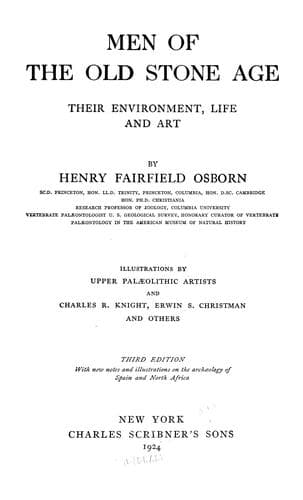
Men of the Old Stone Age: Their Environment, Life and ArtOsborn, Henry Fairfield
History
Men of the Old Stone Age: Their Environment, Life and Art
Osborn, Henry Fairfield
Art, Primitive; Prehistoric peoples; Stone age
The history of the climatic changes in the ancient valley of the Somme is
most clearly written in these successive deposits, 15 feet in thickness,
above the 'lower gravels' at St. Acheul. Along with the Pre-Chellean and
Chellean flints in the 'old gravels' and 'white sands' we find records of
the moist warm temperate climate which then prevailed in northern France
and which undoubtedly was most favorable to the hippopotami, rhinoceroses,
and elephants of those times. The river mollusks found with the late
Chellean flints are another indication of the temperate forest climate
which continued through early Acheulean times.
In the middle Acheulean are found the earliest deposits of 'older loess'
which indicate a climate still temperate but arid, belonging to the middle
of the Third Interglacial Stage. In Mousterian times we find heavy
deposits of gravels corresponding to the moist cold climate of the Fourth
Glacial Stage, followed in middle Aurignacian times by fresh layers of
'newer loess,' indicating the return of a dry climate. Finally, the layers
of loam which were washed down over the sides of the valley, and in which
the remains of Solutrean and Aurignacian camps are found, indicate the
renewal of moist and probably forested conditions.
Thus, two dry loess periods are indicated in this valley, the first or
'older loess' belonging to Third Interglacial times, and the second or
'newer loess' to Postglacial times; and we clearly perceive that in the
culture layers here there is no evidence whatever of more than one
glacial stage preceded by a dry climatic period and deposits of loess. If
the Pre-Chellean flint workers had arrived in this river-valley as early
as Second Interglacial times, we should find proofs of three periods of
arid climate and loess deposition and of two glaciations.
Beginning with middle Acheulean times the flints are found in deposits of
gravels, loams, brick-earths, and 'older loess,' which all belong to a
succeeding geologic stage and are of more recent date than the lower
gravels and sands on the terraces which they overlap and conceal. Deposits
of this kind have also been drifted down from the highest levels toward
the bottom of the valley, and Commont distinguishes three different
depositions or layers of 'loess loam,' the lowest or oldest of which
contain Acheulean flints, while the middle loams contain Mousterian
implements.
Public-domain text, read in full here on John Shaqi.
Reviews
Reviews
No reviews yet
Be the first to share your thoughts on this work.
Elsewhere in the archive
Join the Discussion
Join the discussion
Sign in to leave a comment or review.
Sign InorCreate an account