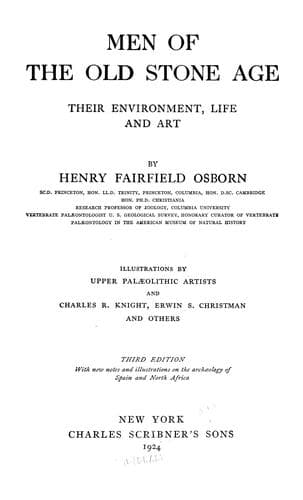
Men of the Old Stone Age: Their Environment, Life and ArtOsborn, Henry Fairfield
History
Men of the Old Stone Age: Their Environment, Life and Art
Osborn, Henry Fairfield
Art, Primitive; Prehistoric peoples; Stone age
Even toward the close of the Third Interglacial Stage there were periods
of warmth, perhaps during the height of the hot summer season, when
animals of the warm fauna migrated from the south. Thus Commont has
recently discovered in the valley of the Somme a station of Mousterian
flint workers, whose industry is associated with remains of the three
animals typical of the warmer climatic phase; namely, the straight-tusked
elephant, the broad-nosed rhinoceros, and the hippopotamus. He has
reaffirmed his belief that the greater part of this chapter of human
prehistory, both as to the surface topography of the Somme valley and the
evolution of the flint cultures from Pre-Chellean to Mousterian times,
occurred during the Third Interglacial Stage.
THE EARLY WARM TEMPERATE PERIOD OF THE PRE-CHELLEAN CULTURE[V]
We have observed that from Torralba in the Province of Soria, Spain, to
Abbeville, near the mouth of the Somme, in the north of France, three
types of animals which entered Europe as early as Upper Pliocene times,
namely, the Etruscan rhinoceros, the horse of Steno, and the sabre-tooth
tiger, are said to occur in connection with early Chellean artifacts. The
two former species may possibly be confused with early forms of Merck's
rhinoceros and the true forest horses of Europe, but there can be no
question as to the identification of the sabre-tooth tiger, numbers of
which were found by M. d'Ault du Mesnil, at Abbeville, on the Somme, with
early Chellean flints.
PRE-CHELLEAN FAUNA
Southern mammoth.
Etruscan rhinoceros.
Hippopotamus.
Primitive horse (_Equus stenonis_)?
Sabre-tooth tiger.
Broad-nosed rhinoceros.
Straight-tusked elephant.
Giant beaver (_Trogontherium cuvieri_).
Short-faced hyæna.
Typical Eurasiatic forest and meadow fauna, including deer, bison, and
wild cattle.
The mammalian life of the Somme at this time, as found in the _gisement du
Champ de Mars_ near Abbeville, is very rich. Among the larger forms there
is certainly the great southern mammoth (_E. meridionalis trogontherii_),
and possibly also the straight-tusked elephant (_E. antiquus_). There are
unquestionably two species of rhinoceros, the smaller of which is
recognized by Boule as the Etruscan, and the larger as Merck's rhinoceros.
Steno's horse is said to occur here, and there are abundant remains of the
great hippopotamus (_H. major_); the sabre-tooth tigers were very numerous
as attested by the discovery of the lower jaws of thirty or more
individuals. The short-faced hyæna (_H. brevirostris_) is also found, and
there are several species of deer and wild cattle.
This remarkably rich collection of mammals is associated with flints of
primitive Chellean or, possibly, of Pre-Chellean type.(12) In Torralba,
Spain, the same very ancient animals occur, and it appears possible that
this was the prevailing mammalian life of Pre-Chellean times.
Public-domain text, read in full here on John Shaqi.
Reviews
Reviews
No reviews yet
Be the first to share your thoughts on this work.
Elsewhere in the archive
Join the Discussion
Join the discussion
Sign in to leave a comment or review.
Sign InorCreate an account