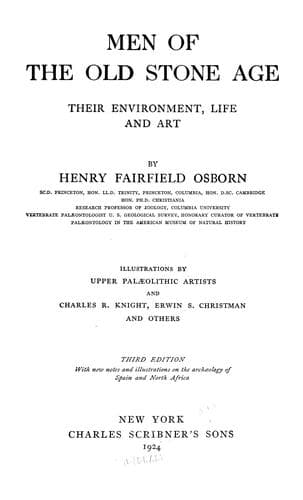
Men of the Old Stone Age: Their Environment, Life and ArtOsborn, Henry Fairfield
History
Men of the Old Stone Age: Their Environment, Life and Art
Osborn, Henry Fairfield
Art, Primitive; Prehistoric peoples; Stone age
The type station of the Chellean culture is somewhat east of the present
town of Chelles. Here in Chellean times the broad floods of the ancient
River Marne were transporting great quantities of sand and débris,
products of the early pluvial periods of Third Interglacial times; and
here, on the right bank, embedded in sands and gravels 24 feet thick, are
found the typical Chellean implements mingled with remains of the
hippopotamus, straight-tusked elephant, Merck's rhinoceros, giant beaver,
hyæna, and many members of the Asiatic forest and meadow fauna.
The flint-working stations at St. Acheul were on bluffs from 40 to 80 feet
above the present level of the Somme. The Chellean and the following
Acheulean industry was carried on here on a very extensive scale. In one
year Rigollot collected as many as 800 coups de poing from the ancient
quarries; near by are other quarries equally rich in material, and we may
imagine that the products of the flint industry in this favorable locality
were carried far and wide into other parts of the country.
In the vicinity of Paris, and again at Arcy, in the valley of the Bièvre,
the workers of Chellean, Acheulean, and Mousterian flints sought in
succession the old river-gravels belonging to the lower levels; these 'low
terraces' are only 15 feet above the present height of the river and are
still occasionally flooded by the high waters of the Seine, indicating
that the Seine borders have not altered their levels. The animal life here
was identical with that of the Somme and of the Thames and included the
hippopotamus, Merck's rhinoceros, and the straight-tusked elephant.
Thus it would appear that, in regard to the river courses and the hills
through which they flowed, the topography and landscape of northern France
and of southern Britain were everywhere the same as at the present time.
The forests which clothed the hills were not greatly different from the
present, except for the presence of a few trees of a warmer clime, nor was
there anything strange or unfamiliar in the majority of the animals that
roamed through forest and meadow. The three chief archaic elements
consisted in the presence of two very ancient races of men and their rude
stage of culture, in the great forms of Asiatic and African life which
mingled with the more familiar native types, and in the broad, continuous
land surfaces which swept off unbroken to the west and southwest.
Public-domain text, read in full here on John Shaqi.
Reviews
Reviews
No reviews yet
Be the first to share your thoughts on this work.
Elsewhere in the archive
Join the Discussion
Join the discussion
Sign in to leave a comment or review.
Sign InorCreate an account