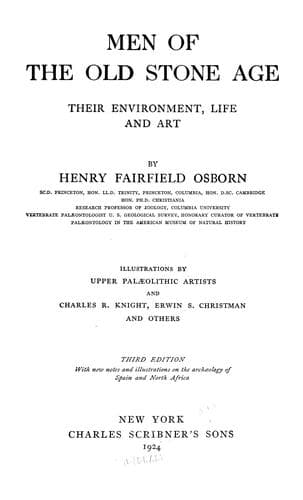
Men of the Old Stone Age: Their Environment, Life and ArtOsborn, Henry Fairfield
History
Men of the Old Stone Age: Their Environment, Life and Art
Osborn, Henry Fairfield
Art, Primitive; Prehistoric peoples; Stone age
For in those days Europe, though even then little more than a great
peninsula, extended far beyond its present limits. England and Ireland
were still part of the mainland, and great rivers flowed through the
broad valleys that are now the Irish Sea, the North Sea, and the English
Channel--rivers that counted the Seine, the Thames, the Garonne, and even
the Rhine, as mere tributaries. The Strait of Gibraltar was then the
Isthmus of Gibraltar--a narrow land bridge connecting Europe with Africa.
The Mediterranean was then an inland lake, or rather two inland lakes, for
Italy and Sicily stretched out in a broad, irregular mass to join the
northern coast of Africa, while Corsica and Sardinia formed a long
peninsula extending from the Italian mainland and almost, if not quite,
reaching to the African coast.
THE THAMES VALLEY IN CHELLEAN TIMES
The interpretation of the features of stratification in the valley of the
Somme is especially interesting because it gives us a key to the
understanding of a similar sequence of prehistoric events in the valley of
the Thames.
The station of Gray's Thurrock in this valley is barely 120 miles distant
from the Chellean station of Abbeville, in the valley of the Somme, and it
is apparent that the old flint workers were freely passing across the
broad intervening country and interchanging their ideas and inventions.
Thus it happened that Chellean implements identical with, or closely
related to, the types of the Somme valley were being fashioned all over
southern Britain from the Thames to the Ouse. The ancient River Thames
(Lyell,(28) Geikie(29)) was then flowing over a bed of boulder-clays which
had been deposited during the preceding glaciations. Its broad, swift
stream was bringing down great deposits of ochreous gravels and of sands
interstratified with loams and clays. It is these old true river-gravels
which display their greatest thickness on the lowest levels of the Thames
and which are largely made up of well-bedded and distinctly water-worn
materials. On these low levels the flint workers sought their materials,
and here they left behind them the archaic Chellean implements which are
now found embedded in these older river-gravels, just as they occur in the
gravels washed down over the three terraces of the Somme and the Marne. In
the Thames this old gravel wash seems to have been down-stream, whereas
on the middle and upper terraces of the Somme the gravel wash came
directly down the sides of the valley, except, perhaps, in very high
floods. These deep beds of gravel, sand, and loam lie for the most part
above the present overflow plain of the Thames, although in some places
they descend below it; which proves that the main landscape of the Thames
also, except for the changes of the flora and of animal life, was the same
in Pre-Chellean and Chellean times as it is at present. Thus the Somme,
the Thames, and the Seine had all worn their channels to the present or
Public-domain text, read in full here on John Shaqi.
Reviews
Reviews
No reviews yet
Be the first to share your thoughts on this work.
Elsewhere in the archive
Join the Discussion
Join the discussion
Sign in to leave a comment or review.
Sign InorCreate an account