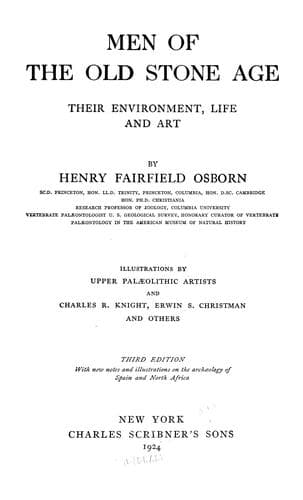
Men of the Old Stone Age: Their Environment, Life and ArtOsborn, Henry Fairfield
History
Men of the Old Stone Age: Their Environment, Life and Art
Osborn, Henry Fairfield
Art, Primitive; Prehistoric peoples; Stone age
These plants are decidedly characteristic of a temperate climate,
including such trees as the oak, yew, and fir, and mostly of species which
are still found in the forests of the same region. This life gave place,
as indicated in plant deposits of a higher level, to an arctic flora,
probably corresponding with the tundra climate of Mousterian times, the
period of the fourth glaciation. Above these are found again layers of
plants and of mollusks which point to the return of a temperate climate.
SPREAD OF THE ACHEULEAN INDUSTRY
It is noteworthy that not a single 'river-drift,' Pre-Chellean or
Chellean, station has been found in Germany or Switzerland, or, in fact,
in all central Europe in the region lying between the Alpine and
Scandinavian glaciers. Either this region was unfavorable to human
habitation or the remains of the stations have been buried or washed away.
It is significant that the earliest proof of human migration into this
region, whether from the east or from the west we do not certainly know,
is coincident with the dry climate of Acheulean times. The 'loess'
conditions of climate seem to be coincident with the earliest Acheulean
stations in Germany, such as Sablon. 'Loess' deposition is by no means a
proof of a cold climate but rather of an arid one, especially in regions
where areas of finely eroded soil were liable to be raised by the wind;
such areas were found over the whole recently glaciated country north of
the Alps and south of the Scandinavian peninsula.
The Palæolithic discovery sites of Germany are principally grouped in
three regions(33) as follows:
To the south, along the _headwaters of the Rhine and the Danube_, among
the limestones of Swabia and the Jura were formed the caverns sought by
early Mousterian man. To the west of these were many older stations in the
'loess' deposits of the upper Rhine, between the mountain ridges of the
Vosges and the Black Forest, and still nearer the sources of the Rhine,
extending over the border into Switzerland, are a number of famous cave
sites in the valleys cut by the Rhine and its tributaries through the
white Jurassic limestone. To the west is the group of the _middle Rhine
and of Westphalia_, which includes the open Acheulean camps in the 'loess'
deposits above the river and a number of cavern stations. To the north is
the scattered group of stations, both of Acheulean and Mousterian times,
of _north Germany_. Here the sites are few and far between. The
open-country camps were established chiefly in the valley of the Ilm and
near the caves of the Harz Mountains, in the neighborhood of Gera. No
discoveries of certain date or unquestioned authenticity are reported from
_eastern Germany_.
Public-domain text, read in full here on John Shaqi.
Reviews
Reviews
No reviews yet
Be the first to share your thoughts on this work.
Elsewhere in the archive
Join the Discussion
Join the discussion
Sign in to leave a comment or review.
Sign InorCreate an account