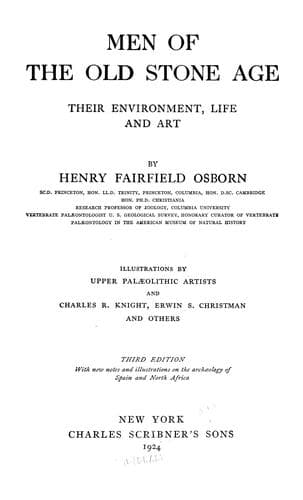
Men of the Old Stone Age: Their Environment, Life and ArtOsborn, Henry Fairfield
History
Men of the Old Stone Age: Their Environment, Life and Art
Osborn, Henry Fairfield
Art, Primitive; Prehistoric peoples; Stone age
even to lower levels when the Pre-Chellean hunters appeared. Since
Chellean times all three rivers have silted up their channels.
The changes along the Thames which have since occurred are in the
superficial layers brought down from the sides of the valley which have
softened the contours of the old terraces and have also entombed the later
phases of the valley's prehistory.
Sections on the south bank at Ilford, Kent, and on the north bank at
Gray's Thurrock, Essex, confirm this view. At the latter station, in
low-lying strata of brick-earth, loam, and gravel, such as would be formed
by the silting up of the bottom of an old river channel, are found the
remains of the straight-tusked elephant, broad-nosed rhinoceros, and
hippopotamus. All the discoveries of recent years lead to the conclusion
that the old fluviatile gravels which contain these ancient mammals and
flints are restricted to the lower levels of the Thames valley, while the
high level gravels and loams are of later date. Old Chellean flints also
occur occasionally on the higher levels, but here it would seem that they
have been washed down from the old land surfaces above, because they are
found mingled with flints of the late Acheulean and early Mousterian
industry.
ENGLAND IN EARLY PALÆOLITHIC TIMES
It is on the higher levels of the Thames, as of the Somme, and in the
superficial deposits covering the sides of the valley that we read the
story of the subsequent Palæolithic cultures and of an early warm
temperate climate being followed by a cold climate with frozen subsoil
belonging to the fourth glaciation and the contemporary Mousterian flint
industry. The Palæolithic history of the Thames(30) has not yet been fully
interpreted, but it would appear that the relics of the old stations of
Kent and Norfolk will yield all the forms of Chellean and Acheulean
implements, and probably also those of the Mousterian which have been
discovered in the valley of the Somme, thus proving that the Lower
Palæolithic races of this region pursued the same culture development as
the neighboring tribes of France and Belgium, as well as those of Spain,
up to the close of middle Acheulean times.
A similar sequence of events appears to be indicated at Hoxne, Suffolk,
where archaic palæoliths were discovered as far back as 1797. This
discovery was neglected for upward of sixty years, until in 1859 these
flints were re-examined by Prestwich and Evans after their visit to the
stations of the Somme (Geikie,(31) Avebury(32)). This site was in the
hollow of a surface of boulder-clay, overlain by the deposit of a
fresh-water stream; in the bed of its narrow channel, besides flint
implements of early Acheulean type, abundant plant remains were found
which give us an interesting vision of the flora of the time.
Public-domain text, read in full here on John Shaqi.
Reviews
Reviews
No reviews yet
Be the first to share your thoughts on this work.
Elsewhere in the archive
Join the Discussion
Join the discussion
Sign in to leave a comment or review.
Sign InorCreate an account