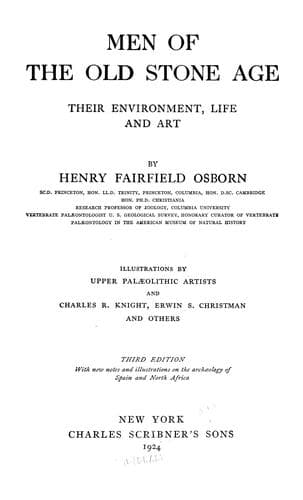
Men of the Old Stone Age: Their Environment, Life and ArtOsborn, Henry Fairfield
History
Men of the Old Stone Age: Their Environment, Life and Art
Osborn, Henry Fairfield
Art, Primitive; Prehistoric peoples; Stone age
The various layers indicate that the cavern was successively occupied by
man; in or near the hearths are found stone implements, broken and
incinerated bones, and pieces of charcoal, which may indicate that this
grotto was visited only at intervals, perhaps during the colder seasons of
the year.
(=1=) Harlé, 1910.1.
(=2=) d'Ault du Mesnil, 1896.1, pp. 284-296.
(=3=) Obermaier, 1912.1, p. 146.
(=4=) Schmidt, 1912.1, pp. 118-126.
(=5=) Boule, 1888.1.
(=6=) Obermaier, 1912.1, pp. 327-329.
(=7=) Haug, 1907.1, vol. II, pp. 327-329.
(=8=) Geikie, 1914.1, p. 262.
(=9=) Morlot, 1854.1.
(=10=) Commont, 1906.1.
(=11=) Geikie, 1914.1, pp. 107-111.
(=12=) d'Ault du Mesnil, _op. cit._
(=13=) Schmidt, 1912.1, pp. 124, 125.
(=14=) Obermaier, 1912.1, p. 118.
(=15=) Dawson, 1913.1; 1913.2; 1913.3.
(=16=) Kennard, 1913.1.
(=17=) Reid, 1913.1.
(=18=) Dawson, 1913.1, p. 123; 1914.1, pp. 82-86.
(=19=) Keith, A., 1913.1; 1913.2; 1913.3.
(=20=) Smith, G. E., 1913.1; 1913.2; 1913.3; 1913.4.
(=21=) Boule, 1913.1, pp. 245, 246.
(=22=) Schwalbe, 1914.1, p. 603.
(=23=) Osborn, 1910.1, pp. 404-409.
(=24=) Ewart, 1904.1; 1907.1; 1909.1.
(=25=) Obermaier, 1912.1, p. 120.
(=26=) de Mortillet, 1869.1.
(=27=) Obermaier, _op. cit._, p. 116.
(=28=) Lyell, 1863.1, p. 164.
(=29=) Geikie, 1914.1, pp. 119, 263, 264.
(=30=) Schmidt, 1912.1, pp. 125, 126.
(=31=) Geikie, _op. cit._, p. 228.
(=32=) Avebury, 1913.1, p. 342, Fig. 236.
(=33=) Schmidt, _op. cit._, pp. 17-105.
(=34=) Breuil, 1912.5, p. 14.
(=35=) Obermaier, 1912.1, p. 164.
(=36=) Obermaier, _op. cit._, pp. 124, 125, 127, 130.
(=37=) Commont, 1908.1.
(=38=) Déchelette, 1908.1, vol. I, pp. 80-90.
(=39=) Geikie, 1914.1, p. 255.
(=40=) Hilzheimer, 1913.1, p. 145.
(=41=) Obermaier, 1912.1, p. 127.
(=42=) Fischer, 1913.1.
(=43=) Gorjanovič-Kramberger, 1901.1; 1903.1; 1906.1.
(=44=) Schwalbe, 1914.1, p. 597.
CHAPTER III
CLOSE OF THE THIRD INTERGLACIAL, TEMPERATE, AND ARID CLIMATE,
ACHEULEAN INDUSTRY--ADVENT OF THE FOURTH GLACIATION, PROFOUND CHANGES
IN ANIMAL AND PLANT LIFE--THE ARCTIC TUNDRA PERIOD OF MAMMALIAN AND
PLANT LIFE--CHARACTERS OF THE NEANDERTHAL RACE, OF THEIR MOUSTERIAN
FLINT INDUSTRY--SUPPOSED CAUSES OF EXTINCTION OR DISPERSAL
We now reach a prolonged and important stage in the prehistory of Europe,
namely, the period of the fourth glaciation, of the final development of
the Neanderthal race of man, of the Mousterian industry, of the beginnings
of cave life, of the chase of the reindeer, and its use for food and
clothing.
In all Europe the Acheulean industry appears to have come to a close
during a period of arid climate, warm in some parts of western Europe and
cool or even cold in others. The seasonal variations may well have been
extreme, as on the steppes of southern Russia, where exceedingly hot
summers may be followed by intensely cold winters, with high winds and
snow-storms destructive of life.
Public-domain text, read in full here on John Shaqi.
Reviews
Reviews
No reviews yet
Be the first to share your thoughts on this work.
Elsewhere in the archive
Join the Discussion
Join the discussion
Sign in to leave a comment or review.
Sign InorCreate an account