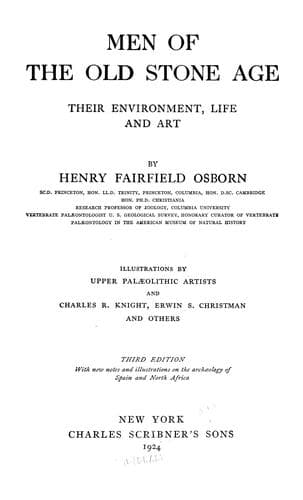
Men of the Old Stone Age: Their Environment, Life and ArtOsborn, Henry Fairfield
History
Men of the Old Stone Age: Their Environment, Life and Art
Osborn, Henry Fairfield
Art, Primitive; Prehistoric peoples; Stone age
It is this seasonal alternation, as well as the recurrence, either
seasonal or secular, of milder climate, which explains the survival or
return of the Asiatic fauna even after the close of the Acheulean industry
and when the Mousterian industry was well advanced.
From deposits found at Grimaldi, in the _Grotte des Enfants_ and in the
_Grotte du Prince_, it has long been said that men of early Mousterian
times lived contemporary with the hippopotamus, the straight-tusked
elephant, and Merck's rhinoceros in the genial climate of the
Mediterranean Riviera. More recently the same animals have been found as
far north as the Somme valley in the 'river-drifts' of
Montières-les-Amiens.(1) Here, again, we find remains of the
hippopotamus, the straight-tusked elephant, and its companion, Merck's
rhinoceros, in Mousterian deposits, a surprising discovery, because it had
always been supposed that a cold climatic period had set in all over
western Europe even before the close of the Acheulean culture. But there
is also evidence of a temperate climate still prevailing in the Thames
valley in the period of the Mousterian 'floors.'(2) Again, along the
Vézère valley, Dordogne, we find that at the station of La Micoque, where
the industry marks the transition between late Acheulean and early
Mousterian times, Merck's rhinoceros is found in the lowest layers
associated with remains of the moose (_Alces_).
There is evidence that Merck's rhinoceros and the straight-tusked elephant
lingered in western Europe during the whole period of the early
development of the Mousterian industry. As observed above, these animals
were hardier than the southern mammoth, which was the first of the Asiatic
mammals to disappear, soon to be followed by its companion, the
hippopotamus. Even after the advent of the closely associated tundra pair,
the woolly mammoth and the woolly rhinoceros, Merck's rhinoceros persists,
as, for example, in the deposits of Rixdorf, near Berlin, where this
ancient type occurs in the same deposits with the woolly mammoth, the
woolly rhinoceros, the reindeer, and the musk-ox, as well as with the
forest forms, the moose, stag, wolf, and forest horse. The extreme
northern latitude of this deposit explains the absence of the
straight-tusked elephant, which may at the time have been living farther
to the south. The same mingling of south and north Asiatic mammals is
found at Steinheim, in the valley of the Murr, some degrees to the west
and south of Rixdorf, not far from Göttingen, where we find Merck's
rhinoceros(3) and the straight-tusked elephant in association with the
woolly mammoth, the woolly rhinoceros, the giant deer, and the reindeer.
Public-domain text, read in full here on John Shaqi.
Reviews
Reviews
No reviews yet
Be the first to share your thoughts on this work.
Elsewhere in the archive
Join the Discussion
Join the discussion
Sign in to leave a comment or review.
Sign InorCreate an account