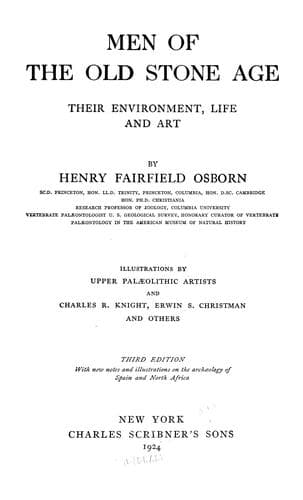
Men of the Old Stone Age: Their Environment, Life and ArtOsborn, Henry Fairfield
History
Men of the Old Stone Age: Their Environment, Life and Art
Osborn, Henry Fairfield
Art, Primitive; Prehistoric peoples; Stone age
Thus the Neanderthal races were entering the Mousterian stage of culture
during the close of the Third Interglacial Stage and during the early
period of the advance of the ice-fields from the great centres in
Scandinavia and the Alps. As these ice-fields slowly approached each
other from the north and from the south a very great period of time must
have elapsed during which all the south Asiatic mammals abandoned western
Europe or became extinct, with the exception of the lions and hyænas,
which became well fitted to the very severe climate that prevailed over
Europe during the fourth glaciation, and even during the long Postglacial
Stage which ensued. The large carnivora readily become thoroughly adapted
to cold climates, as they subsist on animal life wherever it may be found;
tigers of the same stock as those of India have been found as far north as
the river Lena, in latitude 52° 25', where the climate is colder than that
of Petrograd or of Stockholm, while the lion throve in the cold atmosphere
of the upper Atlas range. Thus the cave-lion (_Felis leo spelæa_) and the
cave-hyæna (_H. crocuta spelæa_) doubtless evolved an undercoating of fur
as well as an overcoating of long hair, like the tundra mammals. In size
the lion of this period in France often equalled and sometimes surpassed
its existing relatives, the African and west Asiatic lion; it frequently
figures in the art of the Upper Palæolithic artists and survived in
western Europe to the very close of Upper Palæolithic times.
THE FOURTH GLACIATION
Penck(4) has estimated that the first maximum of the fourth glaciation in
the Alps was reached 40,000 years ago, and that after the recession period
the second maximum ended not less than 20,000 years ago. This would extend
the Mousterian industry over a very long period of time, for there can be
no doubt that the Mousterian culture was practically contemporaneous with
the fourth glaciation, even if a briefer period of time should be allotted
to this great natural event.
The fourth glaciation, like the first, is believed to have been
contemporaneous in Europe and North America,(5) a fact which is of
especial importance to American anthropologists in connection with the
question of the date of arrival of primitive man in America. In both
countries the glaciation reached an early maximum, which was followed by
a period of recession of the ice-fields, a time during which a somewhat
more temperate climate prevailed, but this in turn gave way to a second
advance of as great severity as the first.[AE]
Public-domain text, read in full here on John Shaqi.
Reviews
Reviews
No reviews yet
Be the first to share your thoughts on this work.
Elsewhere in the archive
Join the Discussion
Join the discussion
Sign in to leave a comment or review.
Sign InorCreate an account