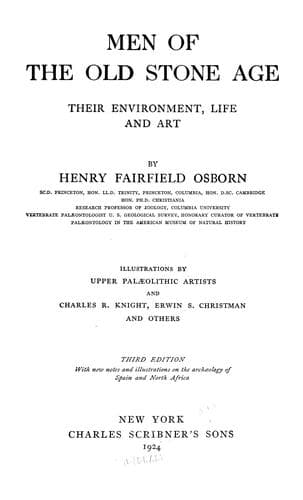
Men of the Old Stone Age: Their Environment, Life and ArtOsborn, Henry Fairfield
History
Men of the Old Stone Age: Their Environment, Life and Art
Osborn, Henry Fairfield
Art, Primitive; Prehistoric peoples; Stone age
In the Iberian peninsula the tundra fauna did not penetrate as far south
as Portugal, although the Norwegian lemming (_Myodes lemmus_) reached the
vicinity of Lisbon. The woolly mammoth, accompanied by the woolly
rhinoceros, has been discovered in two localities on the extreme northern
coast of Spain, in the province of Santander, bordering the Bay of Biscay.
The reindeer (_Rangifer tarandus_) is found in the cavern of Seriña, south
of the Pyrenees; as early as Acheulean times it reached the region of
Altamira, near Santander. Thus Harlé(24) concludes it is certain that the
tundra fauna spread from France westward into Catalonia, along the
northern coast of Spain, flanking the Pyrenees. It is generally believed
that the cave-bear (_Ursus spelæus_) occupied many of the caverns before
their possession by man, and developed certain peculiarities of structure
in these haunts. Thus the phalanges bearing the claws are feebly
developed, indicating that the claws had partly lost their prehensile
function; the anterior grinding-teeth are very much reduced, and the cusps
of the posterior grinders are blunted in a way which is indicative of an
omnivorous diet; yet the front paws were of tremendous size, the body was
thick-set and of heavier proportions than that of the larger recent bears
(_Ursus arctos_) of Europe. Hence, it would appear that the Neanderthals
drove out from the caves a type of bear less formidable than the existing
species but nevertheless a serious opponent to men armed with the small
weapons of the Mousterian period.
CUSTOMS OF THE CHASE AND OF CAVE LIFE
We have only indirect means of knowing the courage and activity of the
Neanderthals in the chase, through the bones of animals hunted for food
which are found intermingled with the flints around their ancient hearths.
These include in the early Mousterian hearths, as we have seen, bones of
the bison, the wild cattle, and the horse, which are followed at
Combe-Capelle by the first appearance of the bones of the reindeer. The
bones of the bison and of the wild horse are both utilized in the bone
anvils of the closing Mousterian culture at La Quina. What we believe to
be the period of the great mammalian life of the region of the upper
Danube is found in the Mousterian levels of the grotto of Sirgenstein,
from which it would appear that the Neanderthals hunted the mammoth, the
rhinoceros, the wild horse, bison, and cattle, and the giant deer as well
as the reindeer. We should keep in mind, however, that when these caves
were for a time deserted, the beasts of prey returned, and so it often
happens that the succeeding layers afford proofs of alternate occupation
by man and by beasts of prey of sufficient size to bring in the larger
kinds of game, while owls may be responsible for the deposits of the
lemming, as in the 'lower rodent layer.'
Public-domain text, read in full here on John Shaqi.
Reviews
Reviews
No reviews yet
Be the first to share your thoughts on this work.
Elsewhere in the archive
Join the Discussion
Join the discussion
Sign in to leave a comment or review.
Sign InorCreate an account