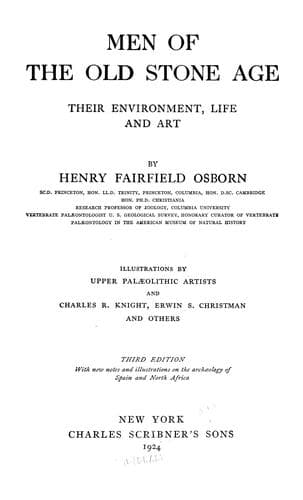
Men of the Old Stone Age: Their Environment, Life and ArtOsborn, Henry Fairfield
History
Men of the Old Stone Age: Their Environment, Life and Art
Osborn, Henry Fairfield
Art, Primitive; Prehistoric peoples; Stone age
Obermaier(25) has given careful study to the vicissitudes of cave life in
Mousterian times. Long before these caves were inhabited by man, they
served as lairs or refuges for the cave-bear and cave-hyæna, as well as
for many birds of prey. For example, the cave of Echenoz-la-Moline, on the
upper waters of the Saône, contained the remains of over eight hundred
skeletons of the cave-bear, and no doubt it cost the Neanderthals many a
hard-fought battle before the beasts were driven out and man possessed
himself of the grotto. Fire may have been the means employed. It has been
questioned whether the caves were not unhealthy dwelling-places, but it
must be remembered that, except in certain caverns which had natural
openings through the roof for the exit of smoke, there was no true cave
life, but rather a grotto life, which centred around the entrance of the
cave. The smallest cave, this author observes, was considerably larger and
better ventilated than the small, smoky cabins of some of the European
peasants, or the snow huts of the Eskimo. The most serious obstacle was
the prevailing dampness, which varied periodically in the caverns, so that
dry seasons were succeeded by abundant moisture seeping through the
limestone roof and down the side walls. At such times the caverns were
probably uninhabitable, and in the bones of both men and beasts many
instances have been observed of diseased swellings and of inflammation of
the vertebræ, such as are caused by extreme dampness. The compensating
advantages were the shelter offered from the rain and cold, a constant
temperature at moderate distances from the entrance, and also the fact
that the caves were very easily defensible, because the entrance was
generally small and the approach often steep and difficult; a high stone
wall across the opening would have made the defense still easier, and a
flaming firebrand would have prevented the approach of bears and other
beasts of prey. On account of this shelter from the weather and wild
beasts the grottos and the larger openings of the caverns were certainly
crowded with the Mousterian flint workers during the inclement seasons of
the year.
Yet the greater part of the life of the Neanderthals was undoubtedly
passed in the open and in the chase. Throughout Mousterian times the
commonest game consisted of the wild horse, wild ox, and reindeer. Both
flesh and pelts were utilized, and the marrow was sought by splitting all
the larger bones. Thus, frequently we find in the hearths the remains of
the mammoth, the woolly rhinoceros, the giant deer, the cave-bear, and the
brown bear. From these beasts of prey the Neanderthal hunters obtained
pelts and perhaps also fat for torches used to light the caverns; there is
no proof of the invention of the lamp at this period.
Public-domain text, read in full here on John Shaqi.
Reviews
Reviews
No reviews yet
Be the first to share your thoughts on this work.
Elsewhere in the archive
Join the Discussion
Join the discussion
Sign in to leave a comment or review.
Sign InorCreate an account