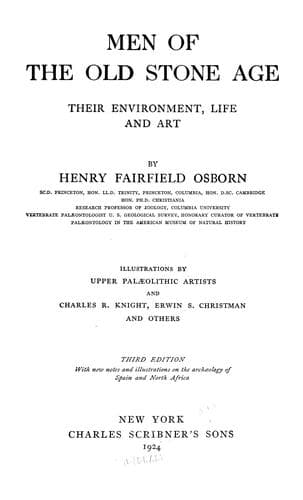
Men of the Old Stone Age: Their Environment, Life and ArtOsborn, Henry Fairfield
History
Men of the Old Stone Age: Their Environment, Life and Art
Osborn, Henry Fairfield
Art, Primitive; Prehistoric peoples; Stone age
The transition from the Mousterian to the Aurignacian appears in the Abri
Audit, which also lies in the valley of the Vézère. Here we still find
irregularly fashioned coups de poing, decadent followers of the
heart-shaped types of the earliest Mousterian industry; this is nearly the
last phase in the decline of the old coup-de-poing manufacture. While the
lance-shaped coup de poing of the late Acheulean never appears in any true
Mousterian industry, the shorter, more heart-shaped type of Combe-Capelle
traverses the entire Mousterian and, after further stages of degeneration,
passes into the Abri Audit culture and even lingers into the early
Aurignacian. At this latter station the typical Mousterian 'points' are
almost wanting.
The Mousterian, observes Schmidt,(75) which preserves the traditions of
the Lower Palæolithic coup-de-poing culture, is one of the most
interesting phases in the development of Palæolithic industry, in that its
successive stages exhibit the very last phases of the great coup-de-poing
industry, of which only the almond and oval scraper types appear, and that
very rarely, in the early Aurignacian. On the other hand, in the late
Mousterian we observe a trend toward the blade (_lame_) industry of the
Upper Palæolithic. Careful study and observation of the subdivisions of
Mousterian culture have thus far been limited to central and southern
France, and they have not yet been traced in Spain; but in the grottos of
Belgium and England the early, middle, and late Mousterian types are known
to exist.
Bone anvils, fashioned out of the hard surfaces of the foreleg and foot
bones of the bison and horse, were discovered at La Quina in 1906. They
show a flattened surface with cross incisions too regular to be accidental
and too far from the articulation to be the result of an inexpert attempt
to sever the joint.(76) This was not the only use of bone in Mousterian
times, however, for primitive pointed implements of bone are occasionally
found in Dordogne, mingled with Mousterian flints. A variety of rudely
fashioned bone implements also occurs at Wildkirchli, in Switzerland.
DISAPPEARANCE OF THE NEANDERTHAL RACE
We have seen that the Neanderthals dwelt in Europe for a very long time,
many thousands of years, during which they doubtless underwent
considerable evolution from lower to higher types, and into varieties,
under the modifying influences of climate, food, and racial habits.
Consequently the known remains of Neanderthals exhibit a decided variation
in head form, as well as in dentition: some are more primitive and
ape-like; others, such as Spy II, are more like the modern races. The
Krapina variety is more broad-headed than the typical Neanderthal variety.
The Gibraltar variety is in many respects of low type. The individual
known as Spy II is of higher type than the other Neanderthals. The
variations in stature so far as known are slight.
Public-domain text, read in full here on John Shaqi.
Reviews
Reviews
No reviews yet
Be the first to share your thoughts on this work.
Elsewhere in the archive
Join the Discussion
Join the discussion
Sign in to leave a comment or review.
Sign InorCreate an account