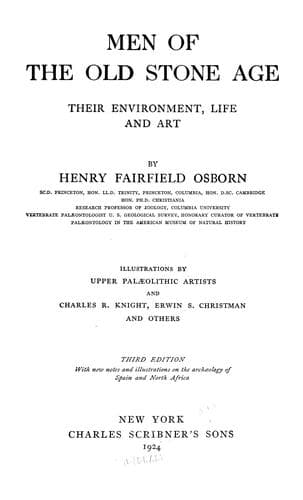
Men of the Old Stone Age: Their Environment, Life and ArtOsborn, Henry Fairfield
History
Men of the Old Stone Age: Their Environment, Life and Art
Osborn, Henry Fairfield
Art, Primitive; Prehistoric peoples; Stone age
For these and other reasons Hrdlička,(77) who has recently made a broad
comparative study of the chief Neanderthal remains of Europe, is of the
opinion that the Neanderthals partly evolved into the lower races of _Homo
sapiens_; being not only in some measure ancestral to such very primitive
forms as the Brünn or Předmost race of Upper Palæolithic times, but even
contributing to the higher race of the Crô-Magnons. He also holds that
traces of Neanderthal blood and physiognomy are not lacking even among
modern Europeans.
A contrary view is set forth in the present volume; namely, that the
Neanderthals represent a side branch of the human race which became wholly
extinct in western Europe. This view the author shares with Boule and with
Schwalbe. Certainly the evidence afforded by the known Upper Palæolithic
burial sites does not support the theory that the Neanderthals persisted.
It is possible, however, that the Upper Palæolithic skeletons discovered
at Předmost, and now awaiting description by Maška, may modify this
conclusion and demonstrate Hrdlička's theory that the Neanderthals
survived and left descendants or men of mixed Neanderthal and _Homo
sapiens_ race along the valley of the Danube.
Whatever may have been their fate in other regions, certainly the most
sudden racial change which we know of in the whole prehistory of western
Europe is the disappearance of the Neanderthal race at the close of the
Mousterian culture stage, which was the latest industrial period of Lower
Palæolithic times, and their replacement by the Crô-Magnon race. From
geologic evidence the date of this replacement is believed to have been
between 20,000 and 25,000 years before our era. So far as we know at
present, the Neanderthals were entirely eliminated; no trace of the
survival of the pure Neanderthal type has been found in any of the Upper
Palæolithic burial sites; nor have the alleged instances of the survival
of the Neanderthal strain or of people bearing the Neanderthal cranial
characters been substantiated. We incline to agree with Boule and Schwalbe
that the supposed cases among modern races of the transmission of
Neanderthal characters are simply low or reversional types, which, upon
close analysis, are never found to present the highly distinctive and
peculiar combination of Neanderthal characteristics.
Public-domain text, read in full here on John Shaqi.
Reviews
Reviews
No reviews yet
Be the first to share your thoughts on this work.
Elsewhere in the archive
Join the Discussion
Join the discussion
Sign in to leave a comment or review.
Sign InorCreate an account