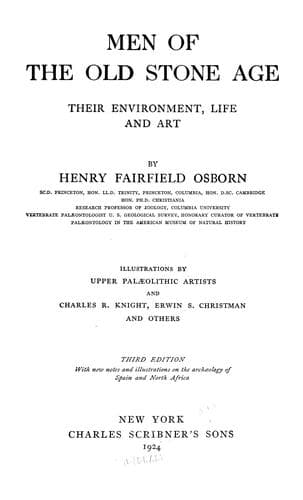
Men of the Old Stone Age: Their Environment, Life and ArtOsborn, Henry Fairfield
History
Men of the Old Stone Age: Their Environment, Life and Art
Osborn, Henry Fairfield
Art, Primitive; Prehistoric peoples; Stone age
The arrival of the Crô-Magnons and the introduction of the Aurignacian
industry are the first events of the prehistory of Europe to which we can
assign a date with any degree of confidence; they correspond geologically
with the close of the fourth glaciation and the beginning of Postglacial
time, the duration of which has been estimated by geologists from evidence
of many different kinds, but which brings us, nevertheless, to
substantially similar conclusions. It seems that 25,000 years is a
conservative estimate for the duration of the Postglacial Period; this is
supported by the independent observations of Lyell, Taylor, Penck and
Brückner, and Coleman; it is within the estimates made by Chamberlin and
Salisbury, Fairchild, Sardeson, and Spencer; it is somewhat larger than
the estimates of Gilbert and Upham.[AJ] Thus, with considerable confidence
we may record man of the modern type of _Homo sapiens_ as entering western
Europe between 25,000 and 30,000 years ago.
The Lower Palæolithic industrial cycle, comprising the Chellean,
Acheulean, and Mousterian, seems to have been similar in evolution both
around the Mediterranean coasts and in the northern portions of Europe.
From the fact that the Crô-Magnons arrived with the Aurignacian industry
it would appear that they came through Phœnicia and along the southern
coasts of the Mediterranean, through Tunis, into Spain; also perhaps along
the northern coasts of the Mediterranean through Italy. Their evolution
had probably taken place somewhere on the continent of Asia, for their
physical structure is entirely of Asiatic type, and not in the least of
African or Ethiopian type; that is, they exhibit no negroid characters
whatever. The reason that Breuil considers that the Aurignacian did not
come in through central or eastern Europe is that there are no early
Aurignacian stations in either region, whereas the Aurignacian is
abundantly developed along the Mediterranean coasts, both of Europe and
Africa. The passage of the Crô-Magnons along these coasts was, therefore,
like the subsequent wave of the true Mediterranean race, dark-haired,
long-headed, narrow-faced people, which followed this coast in early
Neolithic times, or, again, like the wave of the Arabian or Moslem
advance, which pressed forward along the northern coast of Africa and into
southwestern Europe.
[Illustration: FIG. 131. Entrance to the great _Grotte du Prince_ at the
base of the limestone promontory known as the _Baoussé Roussé_, with a
view of Mentone in the distance. After Davanne.]
Public-domain text, read in full here on John Shaqi.
Reviews
Reviews
No reviews yet
Be the first to share your thoughts on this work.
Elsewhere in the archive
Join the Discussion
Join the discussion
Sign in to leave a comment or review.
Sign InorCreate an account