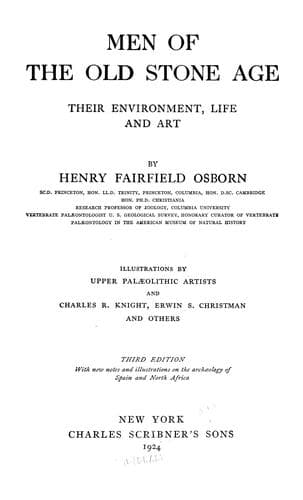
Men of the Old Stone Age: Their Environment, Life and ArtOsborn, Henry Fairfield
History
Men of the Old Stone Age: Their Environment, Life and Art
Osborn, Henry Fairfield
Art, Primitive; Prehistoric peoples; Stone age
(=44=) Boule, 1908.1; 1908.2; 1909.1; 1911.1; 1912.1.
(=45=) Boule, 1913.1.
(=46=) Martin, H., 1911.1.
(=47=) Nicolle, 1910.1.
(=48=) Keith, 1911.1.
(=49=) Fischer, 1913.1, p. 352.
(=50=) Schwalbe, 1914.1, p. 544, Figs. 4 and 5.
(=51=) Fischer, _op. cit._
(=52=) Boule, 1913.1, p. 85.
(=53=) Gorjanovič-Kramberger, 1909.1.
(=54=) Boule, 1913.1, p. 104.
(=55=) Tomes, 1914.1, pp. 588-598.
(=56=) Schwalbe, 1901.2; 1914.1, pp. 534, 535.
(=57=) Schwalbe, 1901.1.
(=58=) Boule, 1913.1.
(=59=) _Op. cit._, pp. 66, 67, 72, 75.
(=60=) Berry, 1914.1.
(=61=) Johnson, 1913.1.
(=62=) Quatrefages, 1884.1, p. 394.
(=63=) Martin, R., 1914.1, p. 645.
(=64=) Boule, 1910.1; 1911.1.
(=65=) Anthony, 1912.1.
(=66=) Boule, 1913.1, p. 119.
(=67=) _Op. cit._, p. 120.
(=68=) Geikie, 1914.1, p. 130; Godwin-Austen, 1840.1.
(=69=) Schmidt, 1912.1, pp. 23, 32, 66, 75, 76, 101, 169.
(=70=) _Op. cit._, p. 128.
(=71=) Schuchhardt, 1913.1, p. 144.
(=72=) Déchelette, 1908.1, vol. I, pp. 98-101.
(=73=) Obermaier, 1912.1, p. 130.
(=74=) Commont, 1909.1.
(=75=) Schmidt, 1912.1, pp. 126-128.
(=76=) Déchelette, 1908.1, vol. I, pp. 104, 105.
(=77=) Hrdlička, 1914.1.
CHAPTER IV
OPENING OF THE UPPER PALÆOLITHIC--THE GRIMALDI RACE--ARRIVAL OF THE
CRÔ-MAGNON RACE AND OF THE AURIGNACIAN INDUSTRY--GEOGRAPHIC AND
CLIMATIC CONDITIONS--MAMMALIAN LIFE--CHARACTERISTICS AND HABITS OF THE
CRÔ-MAGNONS--DISTRIBUTION OF THE AURIGNACIAN INDUSTRY--THE BIRTH OF
ART--ORIGIN AND DISTRIBUTION OF THE SOLUTREAN INDUSTRY--BRÜNN
RACE--SOLUTREAN INDUSTRY AND ART.
In the whole racial history of western Europe there has never occurred so
profound a change as that involving the disappearance of the Neanderthal
race and the appearance of the Crô-Magnon race. It was the replacement of
a race lower than any existing human type by one which ranks high among
the existing types in capacity and intelligence. The Crô-Magnons belonged
to _Homo sapiens_, the same species of man as ourselves, and appear to
have been the chief race of the Upper Palæolithic Period up to the very
close of Magdalenian times, after which they apparently underwent a
decline.
Although there were one or more other races which influenced the
industrial development of western Europe, the Crô-Magnons were certainly
dominant, as shown both by the abundance of their skeletal remains and by
the wide distribution of their industry and art; the Upper Palæolithic may
almost be said to be the period of the Crô-Magnons as the Lower
Palæolithic is that of the Neanderthals and the Pre-Neanderthals. Their
arrival toward the end of Mousterian times effected a social and
industrial change and a race replacement of so profound a nature that it
would certainly be legitimate to separate the Upper Palæolithic from the
Lower by a break equal to that which separates the former from the
Neolithic.(1)
Public-domain text, read in full here on John Shaqi.
Reviews
Reviews
No reviews yet
Be the first to share your thoughts on this work.
Elsewhere in the archive
Join the Discussion
Join the discussion
Sign in to leave a comment or review.
Sign InorCreate an account