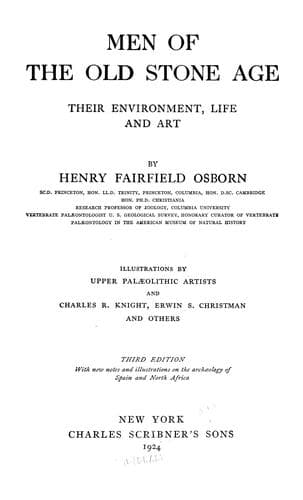
Men of the Old Stone Age: Their Environment, Life and ArtOsborn, Henry Fairfield
History
Men of the Old Stone Age: Their Environment, Life and Art
Osborn, Henry Fairfield
Art, Primitive; Prehistoric peoples; Stone age
There are two very distinct lines of thought among these archæologists:
the first is shown in the tendency to regard the industries as mainly
_autochthonous_, or as following local lines of development; the exponents
of this theory dwell most strongly on the transitions between the
Mousterian, the Aurignacian, and the Solutrean industries. For example,
the chief object of Schuchhardt's tour(9) through the Palæolithic stations
of Dordogne was to observe the transitions from one period to another and
the evidence afforded of successive changes of climate. This writer is
impressed with the transitions; he notes that the typical curved knives of
the Abri Audit furnish a transition from the Mousterian scrapers to the
Aurignacian 'points' of La Gravette and La Font Robert; that the Solutrean
takes up all the fine threads of the Aurignacian culture and spins them
further into Magdalenian times. Thus we get an
Aurignacian-Solutrean-Magdalenian industrial cycle which is comparable to
the Chellean-Acheulean-Mousterian cycle.
Breuil, on the other hand, from the archæologist's standpoint--because he
is not especially interested in the matter of racial development--is a
strong exponent of the idea of _successive invasions_ of cultures, either
from the south or Mediterranean region or from the central region of
Europe, which he calls the 'Atlantic'; and he distinguishes sharply
between these two great areas of Upper Palæolithic evolution, namely, the
_southern_ and the _central_ European, pointing out that it was only after
the establishment of more genial climatic conditions, like those of modern
times, that there was an added element of northern or Baltic invasion.
Certainly the archæologic testimony strongly supports this
culture-invasion hypothesis and it appears to be strengthened in a measure
by the study of the human types, although this study has not progressed
beyond the stage of hypothesis. When the Upper Palæolithic races have been
studied with as close attention as those of the Lower Palæolithic we may
be able to establish positively the relation between these human types and
the advance of certain cultures and industries.
DISTRIBUTION OF UPPER PALÆOLITHIC HUMAN FOSSILS
Our present view, as drawn from a consideration of the facts before us, is
that western Europe in Upper Palæolithic times was entered by four or five
distinct races, all belonging to _Homo sapiens_, only three of which
became established:
5. The _Furfooz_ (Ofnet, and [?] Grenelle) _race_, extremely
broad-headed, entering central Europe possibly from central Asia,
bringing an Azilian culture, without art or developed flint industry.
(Alpine type.)
4. A _dolichocephalic race_ with a narrow face, associated with the
Furfooz race, either connected with the Brünn and Brüx, or an advance
wave of one of the dolichocephalic Neolithic races. (Mediterranean
type.)
Public-domain text, read in full here on John Shaqi.
Reviews
Reviews
No reviews yet
Be the first to share your thoughts on this work.
Elsewhere in the archive
Join the Discussion
Join the discussion
Sign in to leave a comment or review.
Sign InorCreate an account