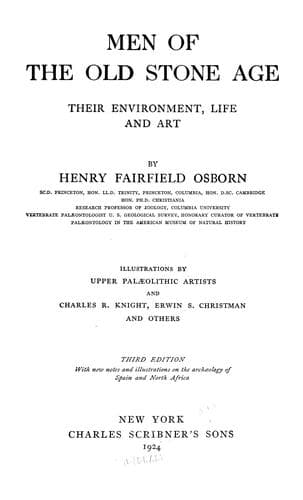
Men of the Old Stone Age: Their Environment, Life and ArtOsborn, Henry Fairfield
History
Men of the Old Stone Age: Their Environment, Life and Art
Osborn, Henry Fairfield
Art, Primitive; Prehistoric peoples; Stone age
_AZILIAN._--Industry of the surviving Crô-Magnon and other resident
races, and of newly arrived brachycephalic and dolichocephalic races
in western Europe; decadent forms of flint and bone workmanship;
entire absence of art. _Daun_ stage of Postglacial retreat; Europe
with a milder climate and forest and meadow fauna like that of early
historic times.
_MAGDALENIAN._--Closing stage of the industry and art of the
Crô-Magnon race; bone implements highly developed; marked decline in
the flint industry. Close of Postglacial Period; climate alternately
cold and moist (corresponding with the _Bühl_ and _Gschnitz_
Postglacial advances of the ice in the Alpine region), or cold and
arid; Europe covered with the tundra and steppe fauna; life chiefly in
the shelters and grottos.
_SOLUTREAN._--Culminating stage of flint industry; apparent invasion
in eastern Europe of the Brünn (Brüx, Předmost, and [?] Galley Hill)
race. The highly developed flint industry of the Solutrean types; art
development of the Crô-Magnon race partly suspended. Dry, cold
climate; life largely in the open.
_AURIGNACIAN._--Appearance of the Crô-Magnon race in southwestern
Europe, succeeding the Mousterian industry; art of engraving and
drawing and sculpture of human and animal forms developing. Animal
life the same as during the fourth glaciation; climate cold and
increasingly dry; life chiefly in the grottos and shelters.
The successive phases of development of Upper Palæolithic industry and art
have been traced with extraordinary precision in Dordogne, in the
Pyrenees, in northern Spain, and along the Danube and upper Rhine by a
host of able workers--Cartailhac, Capitan, Peyrony, Bouyssonnie, Lalanne,
and others. Breuil has made himself master especially of the Aurignacian
and has succeeded Piette as the great historian of Upper Palæolithic art.
Obermaier's chief service has been the comparison of the Upper Palæolithic
of the Danubian region with that of the Dordogne and northern Spain both
in regard to the geologic age and the archæologic and racial succession.
The labors of Schmidt along the upper Rhine and Danube have not only
brought this region into definite prehistoric relation with the Dordogne
and the Pyrenees but have given us by far the clearest evidence of the
relation between the human and the industrial development and the
succession of climatic phases in northern Europe. Finally, the
explorations of Commont along the River Somme have proved that this
region, too, was frequented throughout all Upper Palæolithic times, during
which it exhibits an industrial development hardly less important than
that of the Lower Palæolithic.
Public-domain text, read in full here on John Shaqi.
Reviews
Reviews
No reviews yet
Be the first to share your thoughts on this work.
Elsewhere in the archive
Join the Discussion
Join the discussion
Sign in to leave a comment or review.
Sign InorCreate an account