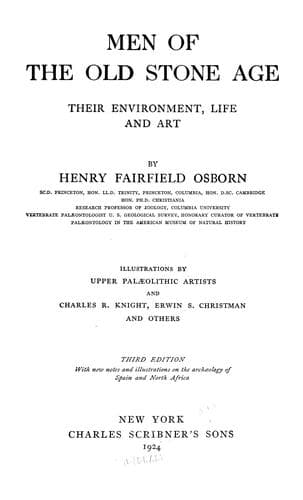
Men of the Old Stone Age: Their Environment, Life and ArtOsborn, Henry Fairfield
History
Men of the Old Stone Age: Their Environment, Life and Art
Osborn, Henry Fairfield
Art, Primitive; Prehistoric peoples; Stone age
Another striking proof of the amelioration of climate is the return of the
flint workers to many of the open stations, old and new, in various parts
of western Europe, the climate being more endurable because less humid. In
Mousterian times the open stations were very rare and were perhaps visited
during the summer season only; in Aurignacian times they were more
abundant, there being twelve open stations out of a total of about sixty
stations thus far discovered; in Aurignacian and Solutrean times the type
station of Solutré was much frequented, and many other open camps are
found in various parts of western Europe.
This is still the Reindeer Period; in fact, it is the typical 'Reindeer
Epoch' of Lartet, and the predominant forms of life are the woolly mammoth
and the woolly rhinoceros; but for a time the reindeer seems to have been
less abundant, and Aurignacian times are marked apparently by a very
greatly increased number of horses. The animal life throughout retains its
northern or arctic character; the tundra species predominate, the hardy
forms of the forests and meadows of Eurasia are next in number, and then
are found a few of the steppe forms, with here and there forms
characteristic of the Alps. The entire fauna of the Aurignacian may be
summed up as follows:
The wild ass, or kiang, of the Asiatic deserts appears in late Aurignacian
times in the region of the upper Rhine and upper Danube, as seen in the
deposits of Wildscheuer, Thaingen, Kesslerloch, and Schweizersbild, and
also there probably arrived in Europe at this time the Elasmothere (_E.
sibericum_), a gigantic rhinoceros, distinguished from all others that we
have been considering by the entire absence of the anterior horn and by
the possession of an enormous single horn situated on the forehead above
the eyes, also by the elaborate foldings of the dental enamel, to which
the name 'Elasmothere' refers; its teeth were especially adapted to a
grassy diet; it apparently wandered into Europe from the arid grassy
plains of central and western Asia, and its appearance is connected with
the extensive deforestation accompanying the tundra and steppe periods of
mammalian life.
TUNDRA LIFE.
Reindeer, woolly mammoth, woolly rhinoceros, musk-ox (rare),
arctic fox, arctic hare, arctic wolverene, arctic ptarmigan.
Banded and Obi lemmings in lower Aurignacian only.
ALPINE LIFE.
Argali sheep, ibex, alpine ptarmigan.
STEPPE LIFE.
Steppe horse, kiang, central Asiatic ass.
FOREST LIFE.
Red deer, roe-deer, giant deer, brown bear, cave-bear, wildcat,
wolf, fox, otter, lynx, weasel.
MEADOW LIFE.
Bison, wild cattle.
ASIATIC LIFE.
Cave-hyæna, cave-lion, ? cave-leopard.
These periodic arrivals from central Asia suggest the existence of
migration routes which may also have been followed by tribes of
Palæolithic hunters.
Public-domain text, read in full here on John Shaqi.
Reviews
Reviews
No reviews yet
Be the first to share your thoughts on this work.
Elsewhere in the archive
Join the Discussion
Join the discussion
Sign in to leave a comment or review.
Sign InorCreate an account