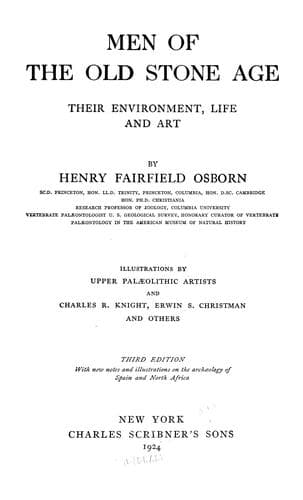
Men of the Old Stone Age: Their Environment, Life and ArtOsborn, Henry Fairfield
History
Men of the Old Stone Age: Their Environment, Life and Art
Osborn, Henry Fairfield
Art, Primitive; Prehistoric peoples; Stone age
There is no evidence at this time of the presence of the more
characteristic animals of the steppes, such as the saiga antelope, the
jerboa, and the steppe hamster, which enter Europe during the later period
of Magdalenian culture. As an indication, perhaps, of the dryness of the
climate we observe that the moose (_Alces_) is no longer recorded,
although it reappears in western Europe in later Magdalenian times. The
giant deer (_Megaceros_) appears in southern Germany with the early
Aurignacian culture, but this would seem to be the time of its extinction,
because it does not occur in association with any of the later industries.
For a time the bison in Dordogne, in southern Germany, and in Austria
appears to be far more abundant than the wild cattle; the latter animals
are not recorded either by Schmidt or Déchelette in association with the
Aurignacian culture, but they reappear in the moister period of
Magdalenian times.
The remains of similar late Pleistocene mammals lie scattered over a large
area in Britain, and we must conclude from their presence, observes
Dawkins,(12) that Britain was still broadly connected with the mainland of
Europe. This is proved by the occurrence of the mammoth fauna in various
places now covered by the sea, as in Holyhead Harbor, off the coasts of
Devonshire and of Sussex, and in the North Sea. On the Dogger Bank the
accumulation of bones, teeth, and antlers is so great that the fishermen
of Yarmouth have collected in their nets and dredges more than three
hundred specimens. They belong to the bear, wolf, cave-hyæna, giant deer,
Irish elk, reindeer, stag, bison, urus, horse, woolly rhinoceros, mammoth,
and beaver, and are to be viewed as the remains of animals deposited by
river currents, as in the case of similar accumulations on land. Had they
been deposited by the sea they would have been sifted by the action of the
waves, the smaller being heaped together in one place and the larger in
another. The carcasses had evidently been collected in the eddies of a
river that helped to form the Dogger Bank, which now rises to within eight
fathoms of the sea-level.
Public-domain text, read in full here on John Shaqi.
Reviews
Reviews
No reviews yet
Be the first to share your thoughts on this work.
Elsewhere in the archive
Join the Discussion
Join the discussion
Sign in to leave a comment or review.
Sign InorCreate an account