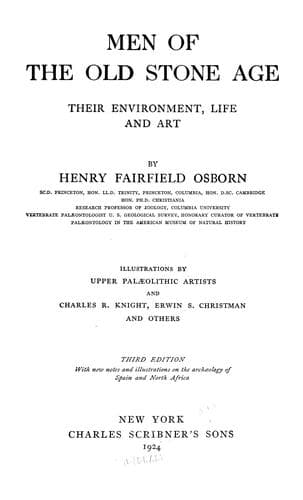
Men of the Old Stone Age: Their Environment, Life and ArtOsborn, Henry Fairfield
History
Men of the Old Stone Age: Their Environment, Life and Art
Osborn, Henry Fairfield
Art, Primitive; Prehistoric peoples; Stone age
Similar customs of burial prevailed widely in Aurignacian times, as we
have observed from the use of color in the Paviland interment of western
Wales and in the Brünn interment of Moravia. This is a feature seldom
found in the Neanderthal burials, although the latter are accompanied by
signs of great reverence and by an abundance of ornaments and finely
finished flints. Up to the present time the races of the Upper Palæolithic
have been studied with far less anatomical precision than those of the
Lower, and the attribution of many of the burials to the Crô-Magnon race
awaits verification.
We have little record of the Paviland burial except that the skeleton was
that of a man of the Crô-Magnon race and colored red. Of the burial of
Aurignac we have no record other than that seventeen skeletons were placed
close together; it would appear that this compound burial may have been
the sequel of a battle or, less probably, that of an epidemic. The type
skeletons of the Crô-Magnon race were simply lying on the surface of a
deep shelter; thus there has always been some doubt as to their exact
archæological age; a large number of perforated shells was found among the
bones, as well as pendants of ivory.
The most remarkable Crô-Magnon burials of undoubted Aurignacian age are
those of the Grottes de Grimaldi; the infant skeletons found here are
neither colored nor decorated, but occurred with a vast number of small
perforated shells (_Nassa_), evidently forming a sort of burial mantle.
Similarly, the female skeleton was enveloped in a bed of shells not
perforated; the legs were extended, while the arms were stretched beside
the body; there were a few pierced shells and a few bits of silex. One of
the large male skeletons of the same grotto had the lower limbs extended,
the upper limbs folded, and was decorated with a gorget and crown of
perforated shells; the head rested on a block of red stone. In the 'man of
Mentone,' found in 1872, the body rested on its left side, the limbs were
slightly flexed, and the forearm was folded; heavy stones protected the
body from disturbance; the head was decorated with a circle of perforated
shells colored in red, and implements of various types were carefully
placed on the forehead and chest. Similarly in the burial of Barma Grande
three skeletons were found placed side by side in a layer of red earth
containing a large quantity of peroxide of iron; two of the skeletons
rested on the left side, the limbs extended or slightly flexed; the
forehead and chest and one of the limbs were encircled with shells.
Public-domain text, read in full here on John Shaqi.
Reviews
Reviews
No reviews yet
Be the first to share your thoughts on this work.
Elsewhere in the archive
Join the Discussion
Join the discussion
Sign in to leave a comment or review.
Sign InorCreate an account