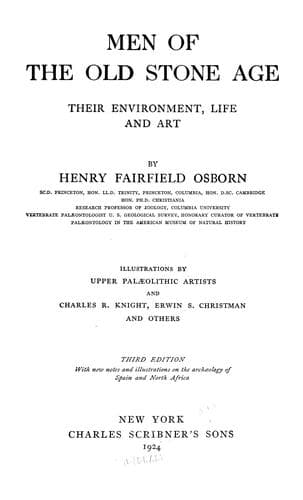
Men of the Old Stone Age: Their Environment, Life and ArtOsborn, Henry Fairfield
History
Men of the Old Stone Age: Their Environment, Life and Art
Osborn, Henry Fairfield
Art, Primitive; Prehistoric peoples; Stone age
In the burial of the so-called Aurignac man of Combe-Capelle, described
above, the limbs were outstretched and the body was decorated with a
necklace of perforated shells and surrounded with a great number of fine
Aurignacian flints. It appears that in all the numerous burials of these
grottos of Aurignacian age and industry of the Crô-Magnon race we have the
burial standards which prevailed in western Europe at this time.
We must infer that the conception of survival after death was among the
primitive beliefs, attested by the placing with the dead of ornaments and
of weapons and in many instances of objects of food. It is interesting to
note that the grottos and shelters were so frequently sought as places of
burial, also that the flexed limbs or extended position of the body
prevailed throughout western Europe into Neolithic times, as well as the
use of color through the Solutrean into Magdalenian times. It is probable
from their love of color in parietal decorations, and from the appearance
of coloring matter in so many of the burials, that decoration of the
living body with color was widely practised, and that color was freshly
applied, either as pigment or in the form of powder, to the bodies of the
dead in order to prepare them for a renewal of life.
AURIGNACIAN FLINT AND BONE INDUSTRY
As pointed out in the introduction of this chapter, the geographical
distribution of the early Aurignacian industry is especially interesting
in its bearing upon the routes by which the Crô-Magnon race entered
Europe. "We can hardly contemplate an origin directly from the east," says
Breuil,(27) "because these earlier phases of the Aurignacian industry have
not as yet been met with in central or eastern Europe." A southerly origin
seems more probable, because the Aurignacian colonies appear to surround
the entire periphery of the Mediterranean, being found in northern Africa,
Sicily, and the Italian and Iberian peninsulas, from which they extended
over the larger part of southern France. In Tunis we find a very primitive
Aurignacian like that of the Abri Audit of Dordogne, with implements
undoubtedly similar to those of Chatelperron, in France. Even far to the
east, in the cave of Antelias, in Syria, as well as in certain stations of
Phœnicia,(28) culture deposits are found which are characteristically
Aurignacian. Again, in southern Italy implements of typical Aurignacian
form, tending toward the superior stage, are found in the grotto of
Romanelli, Otranto.
Public-domain text, read in full here on John Shaqi.
Reviews
Reviews
No reviews yet
Be the first to share your thoughts on this work.
Elsewhere in the archive
Join the Discussion
Join the discussion
Sign in to leave a comment or review.
Sign InorCreate an account