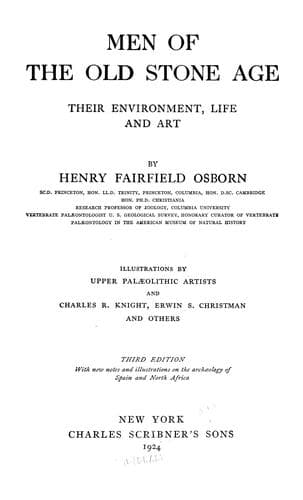
Men of the Old Stone Age: Their Environment, Life and ArtOsborn, Henry Fairfield
History
Men of the Old Stone Age: Their Environment, Life and Art
Osborn, Henry Fairfield
Art, Primitive; Prehistoric peoples; Stone age
A third method of dating the art is still more significant; it is through
a similarity in the engravings on bone, found in the old hearths
associated with flints, to the mural decorations which are found upon the
walls. Thus, at Altamira, engravings on bone associated with Solutrean and
Magdalenian flints enabled Alcalde del Rio and Breuil to date the
engravings on the limestone walls. Hence, in grottos which have never been
closed up and which have been frequented at different times from the
Palæolithic to the present epoch one observes that the mural designs in
the caverns are invariably accompanied by Upper Palæolithic implements
with a similar style of decoration; and this is the case at Font-de-Gaume,
Combarelles, Portel, Mas d'Azil, Castillo, Pasiega, and Hornos de la Peña.
The bone engravings of the female red deer found at Altamira are
identical in their artistic period with those found on the walls of the
same grotto. The excavations at Castillo, where numerous shoulder-blades
of the deer were found engraved in the same style as those of Altamira,
prove that all these engravings and drawings are to be referred to ancient
Magdalenian rather than to upper Solutrean times. The engravings upon the
walls in the grotto of Hornos de la Peña, of Aurignacian times, are dated
through the discovery at the base of the layer of Aurignacian flints of an
engraved equine figure similar to the engravings at Altamira.
A fourth method applies to those not infrequent cases when two or three
designs are superposed one upon the other, from which it necessarily
follows that the underlying designs must antedate those above.
Through the application of these four methods Breuil has succeeded in
dating all the steps in the advance of art from Aurignacian into
Magdalenian times.
ENGRAVING, PAINTING, AND SCULPTURE
In the archaic drawings of the caverns of Pair-non-Pair, La Grèze, and La
Mouthe most of the animal figures are somewhat heavily and deeply
engraved; the proportions are not true; the head is usually too small,
with a large, short body which is often lightly modelled, resting on thin
extremities. Quadrupeds are frequently represented with but two legs, as
in the case of the mammoth. That the powers of observation were only
gradually trained is shown by the fact that details which in later
drawings are well observed are here overlooked; the profile drawings of
animals, with one fore leg and one hind leg represented, are quite like
those of children.
Public-domain text, read in full here on John Shaqi.
Reviews
Reviews
No reviews yet
Be the first to share your thoughts on this work.
Elsewhere in the archive
Join the Discussion
Join the discussion
Sign in to leave a comment or review.
Sign InorCreate an account