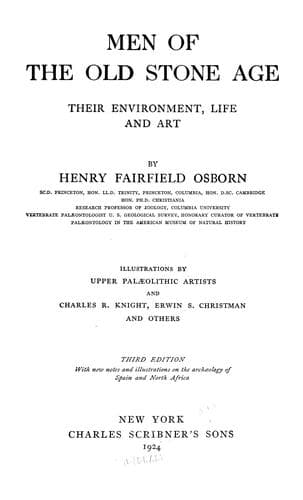
Men of the Old Stone Age: Their Environment, Life and ArtOsborn, Henry Fairfield
History
Men of the Old Stone Age: Their Environment, Life and Art
Osborn, Henry Fairfield
Art, Primitive; Prehistoric peoples; Stone age
Progress toward a true representation of animal form in drawing begins
very early; even in middle Aurignacian times primitive drawing and
engraving commences to replace sculpture. Both the flint 'burins' and the
engravings on the walls of the grottos show that the beginnings of drawing
may be traced back to early Aurignacian times. While the Palæolithic
artists early in the Aurignacian had obtained a certain facility in
plastic work, their drawings, which are solely contours--somewhat
imperfect and deeply engraved lines--show a gradual development. The
degree of skill attained in late Aurignacian times we know from the
engraving of a horse on a stone fragment from Gargas, and from a sketch of
the hinder quarter of a horse found in the cave of Hornos de la Peña,
which is engraved on the frontal bone of one of the wild horses; the
latter is strikingly similar to one of the engravings found at the
entrance to the same grotto. The engravings on a slab of slate of the
heads of two woolly rhinoceroses(37) (Fig. 161) probably belong to the
late Aurignacian. Similar attempts are found in the Abri Lacoste.
Ornamentation develops in the middle Aurignacian, but retains a simple
geometric character.
[Illustration: FIG. 158. Female figurine carved in crystalline talc,
discovered at the _Grottes de Grimaldi_, near Mentone. This figurine,
possibly modelled after one of the Grimaldi negroids, represents the
_enceinte_ condition common to many of these figures. It is peculiar in
showing that abnormal development behind the hips known as steatopygy.
After Reinach.]
The parietal art on the walls of the caverns, mostly deep engravings,
consists of stiff profiles in single lines and in red or black coloring.
The animals represented are the ibex, the horse, the bison, and rarely the
mammoth. The caves where these are found are Pair-non-Pair, La Grèze, La
Mouthe, Bernifal, Font-de-Gaume, Altamira, and Marsoulas. Crucibles for
grinding the color are found in the grotto of Marsoulas, the color being
made by grinding up the red and yellow oxides of iron.
The development of art during the whole Aurignacian is continuous and is
undoubtedly the work of one race; Breuil considers it the work certainly
either of the tall Crô-Magnons or of the small Grimaldis; there is,
however, no evidence of the survival of the Grimaldi race, and we may
safely attribute this entire art development to the Crô-Magnons.
The creative spirit manifested itself along many different lines. In the
fashioning of bone in early Aurignacian times there begins a new industry
capable of great possibilities; out of combinations of lines there develop
geometric figures; in animal figures there is an attempt at simple
symmetric relations, but a full, free composition is not attained. With
further experience in working with bone and ivory, we find in the middle
Aurignacian the first plastic representations of the human figure in the
round.
Public-domain text, read in full here on John Shaqi.
Reviews
Reviews
No reviews yet
Be the first to share your thoughts on this work.
Elsewhere in the archive
Join the Discussion
Join the discussion
Sign in to leave a comment or review.
Sign InorCreate an account