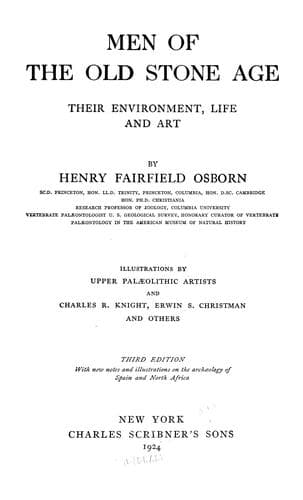
Men of the Old Stone Age: Their Environment, Life and ArtOsborn, Henry Fairfield
History
Men of the Old Stone Age: Their Environment, Life and Art
Osborn, Henry Fairfield
Art, Primitive; Prehistoric peoples; Stone age
There is a possibility(47) that the Brünn race was ancestral to several
later dolichocephalic groups which are found in the region of the Danube
and of middle and southern Germany. Schliz characterizes the Brünn skull
as distinguished by the retreating forehead, by massive eminences above
the orbits separated by a cleft in the median line, by broad, low orbits,
and prominent chin. These characters are met with again in one of the
dolichocephalic skulls found in the interment at Ofnet, at the very
close of Upper Palæolithic times. It would thus appear that the Brünn race
is distinct from the Crô-Magnon race, that it represents a long-headed
type which became established along the Danube as early as Solutrean
times, and that it may possibly be connected with the introduction of some
of the peculiar features of the Solutrean culture.
One of the skeletons of Brünn, found at a depth of 12 feet below the
surface of the 'loess,' was lavishly adorned with tooth-shells, perforated
stone discs, and bone ornaments made from the ribs of the rhinoceros or
mammoth and from the teeth of the mammoth; associated with these was an
ivory idol, apparently of a male figure, of which only the head, the
torso, and the left arm remain. The skeleton and many of the objects found
with the sepulture were partly tinted in red. An ivory figurine belongs to
the Eburnéen stage of Piette and appears to indicate that the burial was
of Aurignacian rather than of Solutrean age.
The Předmost 'mammoth hunters' also probably belonged to this race. They
are represented by the remains of six individuals excavated since 1880 at
Předmost, Moravia, by Wankel, Kr̆íz̆, and Mas̆ka. The bones were found in
a very much shattered condition. Mas̆ka has since discovered a collective
burial of fourteen human skeletons, with remains of six others; the bodies
were covered with stones, but no flints or objects of art were buried with
them. The dimensions of the limbs indicate a race of large stature. The
skeletons were deeply buried in 'loess,' and above and below the rich
archæological layer were abundant débris of the mammoth, representing
between eight and nine hundred specimens. Along with the numerous flints,
including laurel-leaf spear heads of middle Solutrean type, were found
other objects and even primitive works of art in bone and ivory. There is
no question that the human remains belong to the middle Solutrean
stage.(48)
Public-domain text, read in full here on John Shaqi.
Reviews
Reviews
No reviews yet
Be the first to share your thoughts on this work.
Elsewhere in the archive
Join the Discussion
Join the discussion
Sign in to leave a comment or review.
Sign InorCreate an account