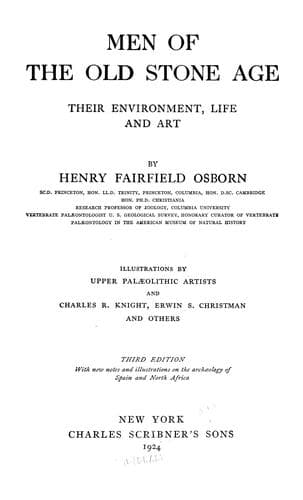
Men of the Old Stone Age: Their Environment, Life and ArtOsborn, Henry Fairfield
History
Men of the Old Stone Age: Their Environment, Life and Art
Osborn, Henry Fairfield
Art, Primitive; Prehistoric peoples; Stone age
With this race is also associated by many authors (Schwalbe, Schliz,
Klaatsch, Keith) the Galley Hill skull, which was found in 1888, buried at
a depth of 8 feet in the 'high terrace' gravels 90 feet above the
Thames.(49) Sollas thinks it highly probable that the remains were in a
natural position and of the same age as the high-level gravels and the
Palæolithic flints and remains of extinct animals which they contained,
but Evans and Dawkins regard the Galley Hill man as belonging to a
long-headed Neolithic race interred in a Palæolithic stratum. The gravels
of the 'high terrace' in which the Galley Hill skull was buried are by no
means of the geologic antiquity of 200,000 years assigned to them by
Keith;(50) they are probably of Fourth Glacial or of Postglacial age, and
lie within the estimates of Postglacial time, namely, from 20,000 to
40,000 years.
The antiquity of the Galley Hill cranial type has been maintained with
ability by Keith. The skull is extremely long or hyperdolichocephalic, the
cephalic index being estimated by Keith at 69 per cent;(51) the brain
capacity is estimated at between 1,350 c.cm. and 1,400 c.cm.; the
cheek-bones are not preserved, so that no judgment can be formed as to
this most distinctive character of the Crô-Magnon race. With this Galley
Hill race Keith also compares the Combe-Capelle, or Aurignacian man of
Klaatsch,(52) although he mistakenly considers the Combe-Capelle man of
much less geologic antiquity. He continues: "Thus, while the writer is
inclined to agree in provisionally assigning the Combe-Capelle man to the
Galley Hill race, he believes that further discoveries will show that the
Combe-Capelle man belongs to a branch marked with certain negroid
features."
SOLUTREAN FLINT INDUSTRY
The 'Solutrean retouch' marks one of the most notable advances in the
technique of flint working; it is altogether distinct from the
'Aurignacian retouch,' which is an heritage from the Mousterian.(53) The
flint is chipped off by _pressure_ in _fine, thin flakes_ from the entire
surface of the implement, to which in its perfected form the craftsman can
give a thin, sharp edge and perfect symmetry. This is a great advance on
the abrupt Aurignacian retouch, in which the flint is chipped back at a
rather blunt angle to make a sharp edge. According to de Mortillet, the
Solutrean method of pressure made possible the execution of much more
delicate work.
Public-domain text, read in full here on John Shaqi.
Reviews
Reviews
No reviews yet
Be the first to share your thoughts on this work.
Elsewhere in the archive
Join the Discussion
Join the discussion
Sign in to leave a comment or review.
Sign InorCreate an account