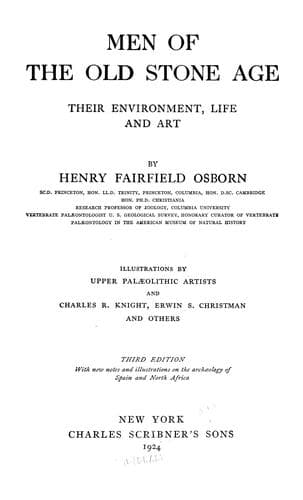
Men of the Old Stone Age: Their Environment, Life and ArtOsborn, Henry Fairfield
History
Men of the Old Stone Age: Their Environment, Life and Art
Osborn, Henry Fairfield
Art, Primitive; Prehistoric peoples; Stone age
which wandered over the steppes and prairies of western Europe from the
beginning of the fourth glaciation until near the close of Postglacial
times.
(=1=) Breuil, 1912.7.
(=2=) Verneau, 1906.1, pp. 202-207.
(=3=) _Op. cit._, p. 204.
(=4=) Keith, 1911.1, p. 60.
(=5=) Obermaier, 1912.1, p. 178.
(=6=) Breuil, 1912.7, p. 174.
(=7=) _Op. cit._, pp. 165-168.
(=8=) Obermaier, 1912.1, pp. 177, 178.
(=9=) Wiegers, 1913.1.
(=10=) Schmidt, 1912.1, p. 266.
(=11=) Geikie, 1914.1, p. 278.
(=12=) Dawkins, 1880.1, pp. 148, 149.
(=13=) Ewart, 1904.1.
(=14=) Obermaier, 1909.2, p. 145.
(=15=) Sollas, 1913.1, p. 325.
(=16=) Broca, 1868.1.
(=17=) Lartet, 1875.1.
(=18=) Verneau, 1886.1; 1906.1, pp. 68, 69.
(=19=) Obermaier, 1912.2.
(=20=) Martin, R., 1914.1, pp. 15, 16.
(=21=) Keith, 1911.1, p. 71.
(=22=) Klaatsch, 1909.1.
(=23=) Keith, _op. cit._, p. 56.
(=24=) Hauser, 1909.1.
(=25=) Fischer, 1913.1.
(=26=) Schliz, 1912.1, p. 554.
(=27=) Breuil, 1912.7, p. 175.
(=28=) _Op. cit._, p. 183.
(=29=) _Op. cit._, pp. 177-180.
(=30=) Schmidt, 1912.1, p. 266.
(=31=) Breuil, _op. cit._, p. 178.
(=32=) Obermaier, 1912.1, p. 181.
(=33=) Breuil, 1912.7, p. 169.
(=34=) Breuil, 1912.1, pp. 194-200.
(=35=) Schmidt, 1912.1.
(=36=) Breuil, _op. cit._
(=37=) Schmidt, 1912.1, p. 142.
(=38=) Breuil, 1912.1, p. 202.
(=39=) Breuil, 1912.6.
(=40=) Hilzheimer, 1913.1, p. 151.
(=41=) Fischer, 1913.1.
(=42=) Makowsky, 1902.1.
(=43=) Schwalbe, 1906.1.
(=44=) Makowsky, _op. cit._
(=45=) Obermaier, 1912.1, pp. 342-355.
(=46=) Martin, R., 1914.1, pp. 15, 16.
(=47=) Schliz, 1912.1.
(=48=) Déchelette, 1908.1, vol. I, p. 28.
(=49=) Keane, 1901.1, p. 147.
(=50=) Keith, 1911.1, p. 30.
(=51=) _Op. cit._, pp. 28-45.
(=52=) _Op. cit._, pp. 51-56.
(=53=) Obermaier, 1912.1, p. 93.
(=54=) Breuil, 1912.7, p. 188.
(=55=) Arcelin, 1869.1.
(=56=) Déchelette, 1908.1, vol. I, pp. 137-141.
(=57=) Schmidt, 1912.1, p. 144, Tafel B.
CHAPTER V
MAGDALENIAN TIMES--CLIMATE AND MAMMALIAN LIFE OF EUROPE--CUSTOMS AND
LIFE OF THE CRÔ-MAGNONS; THEIR INDUSTRY IN FLINT AND BONE; THEIR
DISTRIBUTION--DEVELOPMENT OF THEIR ART, ENGRAVING, PAINTING,
SCULPTURE--ART IN THE CAVERNS--CLIMAX OF THE MAGDALENIAN ART AND
INDUSTRY OF THE CRÔ-MAGNONS--APPARENT DECLINE OF THE RACE.
The art and industrial epoch of Magdalenian times is by far the best known
and most fascinating of the Old Stone Age. This period forms the
culmination of Palæolithic civilization; it marks the highest development
of the Crô-Magnon race preceding their sudden decline and disappearance as
the dominant type of western Europe. The men of this time are commonly
known as the Magdalenians, taking their name from the type station of La
Madeleine, as the Greeks in their highest stage took their name from
Athens and were known as the Athenians.
Public-domain text, read in full here on John Shaqi.
Reviews
Reviews
No reviews yet
Be the first to share your thoughts on this work.
Elsewhere in the archive
Join the Discussion
Join the discussion
Sign in to leave a comment or review.
Sign InorCreate an account