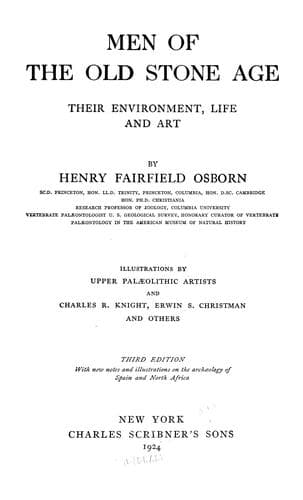
Men of the Old Stone Age: Their Environment, Life and ArtOsborn, Henry Fairfield
History
Men of the Old Stone Age: Their Environment, Life and Art
Osborn, Henry Fairfield
Art, Primitive; Prehistoric peoples; Stone age
We would assign the minimum prehistoric date of 16,000 B. C. for the
beginning of the Magdalenian culture, and since we have assigned to the
beginning of the Aurignacian culture the date of 25,000 B. C., we should
allow 9,000 years for the development of the Aurignacian and Solutrean
industries in western Europe.
INTRODUCTION. INDUSTRIAL AND ARTISTIC DEVELOPMENT
Well as this culture is known, its origin is obscured by the fact that it
shows little or no connection with the preceding Solutrean industry,
which, as we have noted (p. 331), seems like a technical invasion in the
history of western Europe and not an inherent part of the main line of
cultural development. Thus Breuil(1) observes that it appears as if the
fundamental elements of the superior Aurignacian culture had contributed
by some unknown route to constitute the kernel of the Magdalenian
civilization while the Solutrean episode was going on elsewhere. Again,
early Magdalenian art bears striking resemblances to the superior
Aurignacian art of the Pyrenees, especially the parietal art, as shown by
comparing the Aurignacian engravings of Gargas with the early Magdalenian
of Combarelles. Moreover, the same author observes that, if there is one
certain prehistoric fact, it is that the first Magdalenian culture was not
evolved from the Solutrean--that these Magdalenians were newcomers in
western France, as unskilful in the art of shaping and retouching flints
as their predecessors were skilled. Ancient Magdalenian hearths are found
in many localities close to the levels of the upper Solutrean industries
with their shouldered spear points (_pointes à cran_) and highly perfected
flint work. Yet the Magdalenians show a radical departure from the
Solutrean type of flint working; both in Dordogne (Laugerie Haute and
Laussel) and in Charente (Placard) the splinters of flint are massive,
heavy, badly selected, often of poor quality, and poorly retouched,
sometimes almost in an Eolithic manner; at the same time, the chance
flints, that is, the piercers and graving-tools made from splinters of any
accidental shape, are abundant. To these people flint implements appear to
be altogether of secondary importance; although the flints are very
numerous, they are not finished with any of the perfection of the
Solutrean technique; the laurel-leaf spear head and shouldered dart head
have disappeared entirely, but a great variety of smaller graving and
chasing forms are employed for fashioning the implements of bone and horn.
What a contrast to the beautiful flints so finely retouched and of such
carefully selected materials, found in the very same stations in middle
and upper Solutrean layers!
Public-domain text, read in full here on John Shaqi.
Reviews
Reviews
No reviews yet
Be the first to share your thoughts on this work.
Elsewhere in the archive
Join the Discussion
Join the discussion
Sign in to leave a comment or review.
Sign InorCreate an account