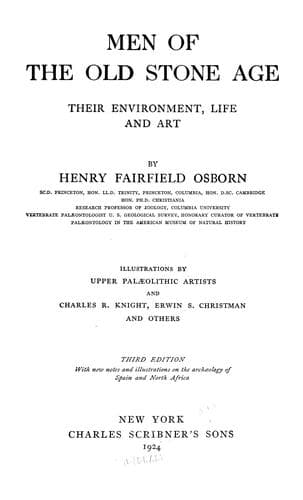
Men of the Old Stone Age: Their Environment, Life and ArtOsborn, Henry Fairfield
History
Men of the Old Stone Age: Their Environment, Life and Art
Osborn, Henry Fairfield
Art, Primitive; Prehistoric peoples; Stone age
From the uniform character of Palæolithic art in its highest forms of
engraving, painting, and animal sculpture we may infer the probable unity
of the Crô-Magnon race, especially throughout western Europe. During
Magdalenian times various branches of art reached their highest point and
were the culmination of a movement begun in the early Aurignacian. The
artist, whose life brought him into close touch with nature and who
evidently followed the movements both of the individual animals and of the
herds for hours at a time, has rendered his observations in the most
realistic manner. Among the animals represented are the bison, mammoth,
wild horse, reindeer, wild cattle, deer, and rhinoceros; less frequent are
representations of the ibex, wolf, and wild boar, and there are
comparatively few representations of fishes or of any form of plant life;
the nobler beasts of prey, such as the lion and the bear, are often
represented, but there are no figures of the skulking hyæna, which at that
time was a rare if not almost extinct animal. While many figures are of
real artistic worth and reach a high level, others are more or less crude
attempts; the composition of figures or of groups of animals is rarely
undertaken.
[Illustration: FIG. 178. Crude sculpture of the ibex, from the Magdalenian
deposit at Mas d'Azil on the right bank of the Arize. After Piette. A
little less than actual size.]
The artistic sense of these people is also manifest in the decoration of
their household utensils and weapons of the chase. Here the smaller
animals of the chase, the saiga, the ibex, and the chamois, are executed
with a sure hand. Sculpture of animal forms in the large, which begins in
Solutrean times, is continued and reaches its highest point in the early
Magdalenian. At this period the use of sculpture as a means of decoration
arises and extends into the middle and late Magdalenian. These latter
divisions are also distinguished by the reappearance of human figurines,
nude, like the Aurignacian, and occasionally somewhat more slender. Thus
it would appear that the artistic spirit, more or less dormant in
Solutrean times, was revived.
Public-domain text, read in full here on John Shaqi.
Reviews
Reviews
No reviews yet
Be the first to share your thoughts on this work.
Elsewhere in the archive
Join the Discussion
Join the discussion
Sign in to leave a comment or review.
Sign InorCreate an account