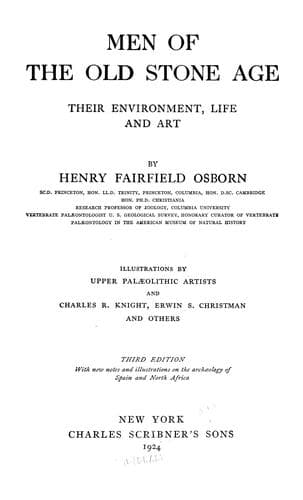
Men of the Old Stone Age: Their Environment, Life and ArtOsborn, Henry Fairfield
History
Men of the Old Stone Age: Their Environment, Life and Art
Osborn, Henry Fairfield
Art, Primitive; Prehistoric peoples; Stone age
In the variety of industries we find evidences of a race endowed with
closely observant and creative minds, in which the two chief motives of
life seem to have been the chase and the pursuit of art. The Magdalenian
flints are fashioned in a somewhat different manner from the Solutrean:
long, slender flakes or 'blades' with little or no retouch are frequent,
and in other implements the work is apparently carried only to a point
where the flint will serve its purpose. No attempt is made to attain
perfect symmetry. Thus the old technical impulse of the flint industry
seems to be far less than that among the makers of the Solutrean flints,
while a new technical impulse manifests itself in several branches of art:
arms and utensils are carved in ivory, reindeer horn and bone, and
sculpture and engraving on bone and ivory are greatly developed. We find
that these people are beginning to utilize the walls of dark, mysterious
caverns for their drawings and paintings, which show deep appreciation for
the perfection of the animal form, depicted by them in most lifelike
attitudes.
We may infer that there was a tribal organization, and it has been
suggested that certain unexplained implements of reindeer horn, often
beautifully carved and known as 'bâtons de commandement,' were insignia of
authority borne by the chieftains.
There can be little doubt that such diversities of temperament, of talent,
and of predisposition as obtain to-day also prevailed then, and that they
tended to differentiate society into chieftains, priests, and
medicine-men, hunters of large game and fishermen, fashioners of flints
and dressers of hides, makers of clothing and footwear, makers of
ornaments, engravers, sculptors in wood, bone, ivory, and stone, and
artists with color and brush. In their artistic work, at least, these
people were animated with a compelling sense of truth, and we cannot deny
them a strong appreciation of beauty.
[Illustration: PL. VII. Crô-Magnon man in the cavern of Font-de-Gaume,
Dordogne, restored in the act of drawing the outlines of one of the bisons
on the wall of the _Galerie des Fresques_. Drawn under the direction of
the author by Charles R. Knight.]
It is probable that a sense of wonder in the face of the powers of nature
was connected with the development of a religious sentiment. How far their
artistic work in the caverns was an expression of such sentiment and how
far it was the outcome of a purely artistic impulse are matters for
very careful study. Undoubtedly the inquisitive sense which led them into
the deep and dangerous recesses of the caverns was accompanied by an
increased sense of awe and possibly by a sentiment which we may regard as
more or less religious. We may dwell for a moment on this very interesting
problem of the origin of religion during the Old Stone Age, so that the
reader may judge for himself in connection with the ensuing accounts of
Magdalenian art.
Public-domain text, read in full here on John Shaqi.
Reviews
Reviews
No reviews yet
Be the first to share your thoughts on this work.
Elsewhere in the archive
Join the Discussion
Join the discussion
Sign in to leave a comment or review.
Sign InorCreate an account