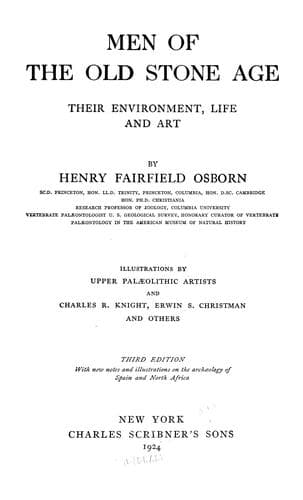
Men of the Old Stone Age: Their Environment, Life and ArtOsborn, Henry Fairfield
History
Men of the Old Stone Age: Their Environment, Life and Art
Osborn, Henry Fairfield
Art, Primitive; Prehistoric peoples; Stone age
Second, it would appear that in middle Magdalenian times, after the _Bühl_
advance, there occurred a temporary retreat of the ice-fields, and that
during this period the full tide of life from the steppes of western Asia
and eastern Europe for the first time spread over western Europe,
including especially such animals as the jerboa and the saiga antelope,
the dwarf pika and steppe hamster. Correlation is very hazardous, but this
ice retreat may correspond with the _Upper Forestian_, or Fifth
Interglacial Stage in Scotland, described by Geikie, the stage which he
mentions as marked by the elevation of the Scottish coast with the retreat
of the sea beyond the present coast-lines; geographic changes which were
accompanied by the disappearance of perennial snow and ice, and the return
of more genial conditions. The tundra fauna still prevailed; such a
typical arctic animal as the musk-ox wandered as far south as Dordogne and
the Pyrenees, and became one of the objects of the chase. During what is
known as the middle or 'full Magdalenian' the tundra, steppe, alpine,
forest, and meadow faunæ spread over the plains and valleys throughout
western Europe.
Third, the second Postglacial advance, known as the _Gschnitz_ stage in
the Alpine region, appears to have been contemporaneous with the closing
period of Magdalenian culture. This was the last great effort of the
ice-fields to conquer western Europe, and in the Alpine region the
snow-line descended 1,800 feet below the present levels; it marked the
closing stage of the long cold climatic period that had favored the
presence of the reindeer, the woolly mammoth, and the woolly rhinoceros in
western Europe, as well as the close of the 'Reindeer Epoch' of Lartet.
Again, in the north of Britain Geikie observes an _Upper Turbarian_ or
Sixth Glacial Epoch, accompanied by a partial subsidence of the Scottish
coast, and the return of a cold and wet climate; there is evidence of the
existence of snow glaciers upon the high mountains only. The _Gschnitz_
stage marks the end of glacial conditions in Europe, the retreat of the
tundra and steppe faunæ, and the predominance of the forest and meadow
environment and life.
In the Alps there was, however, still a final effort of the glaciers,
known as the _Daun_ stage, which, it is believed, broadly corresponds with
the period of the Azilian-Tardenoisian industry, and a climatic condition
in Europe favorable to the spread of the Eurasiatic forest and meadow
life.
Public-domain text, read in full here on John Shaqi.
Reviews
Reviews
No reviews yet
Be the first to share your thoughts on this work.
Elsewhere in the archive
Join the Discussion
Join the discussion
Sign in to leave a comment or review.
Sign InorCreate an account