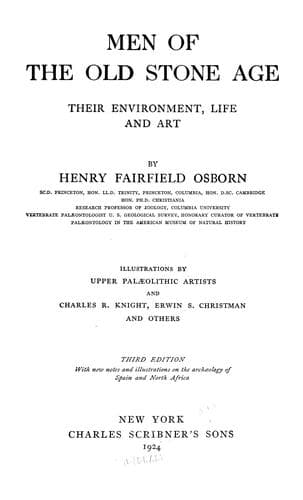
Men of the Old Stone Age: Their Environment, Life and ArtOsborn, Henry Fairfield
History
Men of the Old Stone Age: Their Environment, Life and Art
Osborn, Henry Fairfield
Art, Primitive; Prehistoric peoples; Stone age
The key to this great prehistoric chronology is found in palæontology. The
arctic tundra rodents especially are the most invaluable timekeepers;
according to Schmidt(5) there is no doubt whatever that the _Upper Rodent
Layer_, composed of the animals of the second invasion from the arctic
tundras, corresponds, on the one hand, with the beginning of the
Magdalenian industry and, on the other, with the renewed glacial advance
in the Alpine region, known as the _Bühl_ stage, and probably also with
that in the north. The _Upper Rodent Layer_ of Magdalenian times is found
in the remarkably complete succession of deposits at the stations of
Schweizersbild and Kesslerloch, which are more recent in time than the
'low terraces' bordering the neighboring River Rhine. The fossil animals
prove that after the extreme cold of early Magdalenian times the tundra
fauna gradually gave way to a wide-spread steppe fauna. Along the Rhine
and the Danube the banded lemmings become less frequent; the jerboas,
hamsters, and susliks of the steppes become more abundant. Exactly similar
changes are observed in Dordogne. In Longueroche, on the Vézère, there
occur for the first time in western Europe great numbers of rabbits
(_Lepus cuniculus_); numerous hares (_Lepus timidus_) are also observed at
the type station of La Madeleine, especially in the uppermost and
lowermost culture layers. These small rabbits probably came from the
Mediterranean region and denote a slight elevation of temperature. But it
is only in the very highest Magdalenian layers that the animal life of
western Europe begins to approach that of recent times, namely, that of
the prehistoric forest and meadow faunæ.
MAMMALIAN LIFE OF MAGDALENIAN TIMES
Thus it is very important to keep in mind that during Magdalenian times
there were both cold and moist periods favorable to tundra life and cold
and arid periods favorable to steppe life. In the latter were deposited
the sheets of 'upper loess.'
The mammalian life of Magdalenian times is of interest not only in
connection with the climate and environment of the Crô-Magnon race, but
with the development of their industry and especially of their art. It is
noteworthy that the imposing forms of animal life, the mammoth among the
tundra fauna and the bison among the meadow fauna, made a very strong
impression and were the favorite subjects of the draftsmen and colorists;
but the eye was also susceptible to the beauty of the reindeer, the stag,
and the horse and to the grace of the chamois. The artists and sculptors
have preserved the external appearance of more than thirty forms of this
wonderful mammalian assemblage, which accord exactly with the fossil
records preserved in the fire-hearths of the grottos and shelters, and
with the deposits assembled by beasts and birds of prey in the uninhabited
caverns.
Public-domain text, read in full here on John Shaqi.
Reviews
Reviews
No reviews yet
Be the first to share your thoughts on this work.
Elsewhere in the archive
Join the Discussion
Join the discussion
Sign in to leave a comment or review.
Sign InorCreate an account