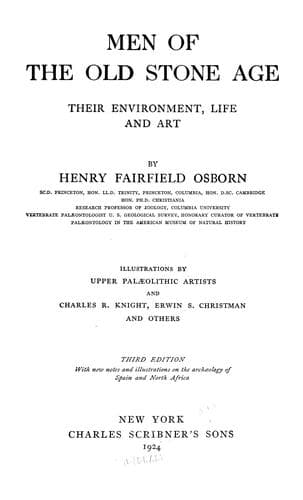
Men of the Old Stone Age: Their Environment, Life and ArtOsborn, Henry Fairfield
History
Men of the Old Stone Age: Their Environment, Life and Art
Osborn, Henry Fairfield
Art, Primitive; Prehistoric peoples; Stone age
The regions of the northern Alps bordering the great glaciers of the
_Bühl_ and _Gschnitz_ advances, were barren stretches of rock, and the
valleys and plateaus now free from ice became tundras, where the swamps
alternated with patches of polar willows and stunted fir-trees, while
other areas were covered with low, scrubby birches, or reindeer moss and
lichens. The return of these hard conditions of life undoubtedly exerted a
great influence both upon the physical and mental development of the
Crô-Magnon race; it was at the very period when the life conditions in
western Europe were most severe that the artistic development of these
people began to revive. Forced to return to the shelters and grottos,
which certainly were less frequented in Solutrean times, there was time
for the development of the imagination and for its expression both in the
mobile and parietal arts. There was a less vigorous development of the
flint industry, and apparently a degeneration in physique and stature.
In Germany and northern Switzerland, on the headwaters of the Rhine and
the Danube, the entrance and departure of the northern waves of life are
recorded, especially in the grottos of Sirgenstein, Schussenquelle,
Andernach, Schmiechenfels, and Propstfels. It would appear that the woolly
mammoth and the woolly rhinoceros were not hunted in this region, for
their remains are not preserved in any of the grottos or stations mingled
with the middle or late Magdalenian cultures. On the other hand, we find
the steppe horse, the kiang, the stag, and the reindeer very abundant
indeed. The bison is absent, and wild cattle are very rare; so that this
region is not typical of the mammalian life of Magdalenian times as found
in Dordogne and in the Pyrenees.
The migration of the woolly mammoth and woolly rhinoceros along the
Pyrenees and westward into the Cantabrian Mountains, and the crossing of
the Pyrenees by the reindeer, have already been described. In the mural
frescos of Font-de-Gaume, Dordogne, it is noteworthy that the very latest
engravings are those of the mammoth superposed on the fine polychromes
which belong to the period of middle Magdalenian art.
THE DRY STEPPE CLIMATE OF MIDDLE MAGDALENIAN TIMES
Public-domain text, read in full here on John Shaqi.
Reviews
Reviews
No reviews yet
Be the first to share your thoughts on this work.
Elsewhere in the archive
Join the Discussion
Join the discussion
Sign in to leave a comment or review.
Sign InorCreate an account