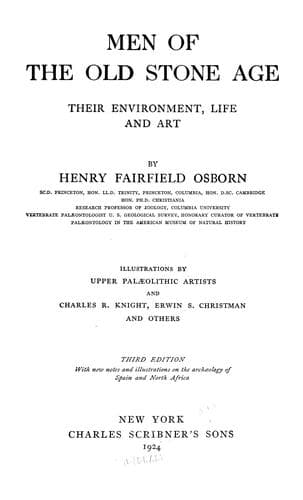
Men of the Old Stone Age: Their Environment, Life and ArtOsborn, Henry Fairfield
History
Men of the Old Stone Age: Their Environment, Life and Art
Osborn, Henry Fairfield
Art, Primitive; Prehistoric peoples; Stone age
The cold, dry period, when the full tide of steppe life reached western
Europe, is of somewhat uncertain date; it probably began during the stage
of the middle Magdalenian industry and continued into the late or high
Magdalenian. There was certainly an environment attractive to these
peculiar and very highly specialized mammals, which at the present time
are neutral in color, swift of foot, inured to existence on very sparse
vegetation, and adapted to extremes of heat and cold. Among the smaller
steppe forms were the suslik or pouched marmot of the steppes
(_Spermophilus rufescens_) and the steppe hamster (_Cricetus phæus_), also
the Siberian vole (_Arvicola gregalis_); still more characteristic was the
great jerboa (_Alactaga jaculus_), with long, springy hind legs, and the
saiga antelope (_Antilope saiga_). With these mammals appeared the steppe
grouse (_Perdix cinerea_), which is found along the Danube in late
Magdalenian strata; another bird characteristic of the northern steppes
and tundras is the 'woodcock owl' (_Brachyotus palustris_). Accompanying
these mammals was undoubtedly the steppe horse (_Equus przewalski_), now
restricted to the desert of Gobi; it is said to occur in the grottos of
northern Switzerland.
It would appear that the saiga antelope may have reached eastern Europe in
late Solutrean times, for its outline is said to be found in an engraving
at Solutré. Widely spread over Europe was the giant Elasmothere; it would
seem very unlikely that this animal was present in Magdalenian times, for
it certainly would have attracted the attention of the artists. Neither
have we any positive artistic records of the wild ass, or kiang, although
certain of the drawings in the grottos of Niaux and Marsoulas, of the
middle Magdalenian, also of Albarracin, in Spain, may be interpreted as
representing this animal. Thus the Asiatic steppe and desert fauna, which
in the region of the upper Rhine and Danube was restricted to two
species of mammals in Aurignacian and Solutrean times, rises to nine or
ten species in middle Magdalenian times, so that for the first time during
the entire 'Reindeer Epoch' the steppe and tundra faunæ are equally
balanced. There are also six or seven species of birds from the moors and
uplands of central Asia. The bird life depicted in middle Magdalenian art
includes the ptarmigan or grouse, the wild swan, geese, and ducks.
Public-domain text, read in full here on John Shaqi.
Reviews
Reviews
No reviews yet
Be the first to share your thoughts on this work.
Elsewhere in the archive
Join the Discussion
Join the discussion
Sign in to leave a comment or review.
Sign InorCreate an account