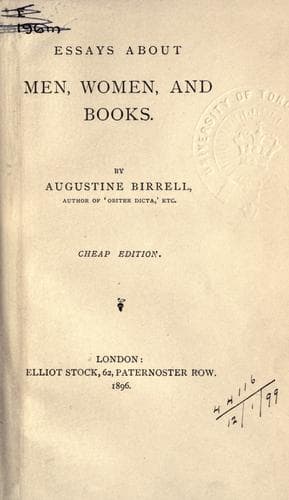
Then there is Stella’s Swift. As for Stella herself, I have never felt
I knew enough about her to join very heartily in Thackeray’s raptures:
‘Who has not in his mind an image of Stella? Who does not love her?
Fair and tender creature! Pure and affectionate heart.... Gentle lady!
so lovely, so loving, so unhappy.... You are one of the saints of
English story.’ This may be so, but all I feel I know about Stella is,
that Swift loved her. That is certain, at all events.
‘If this be error, and upon we proved,
I never writ, and no man ever loved.’
The verses to Stella are altogether lovely:
‘But, Stella, say what evil tongue
Reports you are no longer young,
That Time sits with his scythe to mow
Where erst sat Cupid with his bow,
That half your locks are turned to gray
I’ll ne’er believe a word they say.
’Tis true, but let it not be known,
My eyes are somewhat dimmish grown.’
And again:
‘Oh! then, whatever Heaven intends,
Take pity on your pitying friends!
Nor let your ills affect your mind
To fancy they can be unkind.
Me, surely me, you ought to spare
Who gladly would your suffering share,
Or give my scrap of life to you
And think it far beneath your due;
You, to whose care so oft I owe
That I’m alive to tell you so.’
We are all strangely woven in one piece, as Shakespeare says. These
verses of Swift irresistibly remind their readers of Cowper’s lines to
Mrs. Unwin.
Swift’s prose is famous all the world over. To say anything about
it is superfluous. David Hume indeed found fault with it. Hume paid
great attention to the English language, and by the time he died had
come to write it with much facility and creditable accuracy; but
Swift is one of the masters of English prose. But how admirable
also is his poetry--easy, yet never slipshod! It lacks one quality
only--imagination. There is not a fine phrase, a magical line to be
found in it, such as may occasionally be found in--let us say--Butler.
Yet, as a whole, Swift is a far more enjoyable poet than Butler.
Swift has unhappily written some abominable verses, which ought never
to have been set up in type; but the ‘Legion Club,’ the verses on
his own death, ‘Cadenus and Vanessa,’ the ‘Rhapsody on Poetry,’ the
tremendous lines on the ‘Day of Judgment,’ and many others, all belong
to enjoyable poetry, and can never lose their freshness, their charm,
their vitality. Amongst the poets of the eighteenth century Swift sits
secure, for he can never go out of fashion.
Public-domain text, read in full here on John Shaqi.
Reviews
Reviews
No reviews yet
Be the first to share your thoughts on this work.
Join the Discussion
Join the discussion
Sign in to leave a comment or review.
Sign InorCreate an account