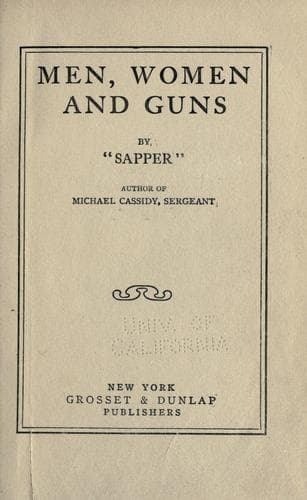
War stories, English; World War, 1914-1918 -- Fiction
When Jim Denver told Lady Alice Conway that he was sane again, he spoke
no more than the truth. A few weeks in France, and then a shattered arm
had brought him back to England with more understanding than he had ever
possessed before. He had gone out the ordinary Englishman--casual,
sporting, easy going, somewhat apathetic; he had come back a thinker as
well, at times almost a dreamer. It affects different men in different
ways--but none escape. And that is what those others cannot
understand--those others who have not been across. Even the man who
comes back on short leave hardly grasps how the thing has changed him:
hardly realises that the madness is still in his soul. He has not time;
his leave is just an interlude. He is back again in France almost before
he realises he has left it. In mind he has never left it.
There is humour there in plenty--farce even; boredom, excitement,
passion, hatred. Every human emotion runs its full gamut in the Land of
Topsy Turvy; in the place where the life of a man is no longer
three-score years and ten, but just so long as the Great Reaper may
decide and no more. And you are caught in the whirl--you are tossed here
and there by a life of artificiality, a life not of one's own seeking,
but a life which, having once caught you, you are loath to let go.
Which is a hard saying, and one impossible of comprehension to those who
wait behind--to the wives, to the mothers, to the women. To them the
leave-train pulling slowly out of Victoria Station, with their man
waving a last adieu from the carriage window, means the ringing down of
the curtain once again. The unknown has swallowed him up--the unknown
into which they cannot follow him. Be he in a Staff office at the base
or with his battalion in the trenches, he has gone where the woman to
whom he counts as all the world cannot even picture him in her mind. To
her Flanders is Flanders and war is war--and there are casualty lists.
What matter that his battalion is resting; what matter that he is going
through a course somewhere at the back of beyond? He has gone into the
Unknown; the whistle of the train steaming slowly out is the voice of
the call-boy at the drop curtain. And now the train has passed out of
sight--or is it only that her eyes are dim with the tears she kept back
while he was with her?
At last she turns and goes blindly back to the room where they had
breakfast; she sees once more the chair he used, the crumpled morning
paper, the discarded cigarette. And there let us leave her with
tear-stained face and a pathetic little sodden handkerchief clutched in
one hand. "O God! dear God! send him back to me." Our women do not show
us this side very much when we are on leave; perhaps it is as well, for
the ground on which we stand is holy....
* * * * *
And what of the man? The train is grinding through Herne Hill when he
puts down his _Times_ and catches sight of another man in his brigade
also returning from leave.
Public-domain text, read in full here on John Shaqi.
Reviews
Reviews
No reviews yet
Be the first to share your thoughts on this work.
Elsewhere in the archive
Join the Discussion
Join the discussion
Sign in to leave a comment or review.
Sign InorCreate an account