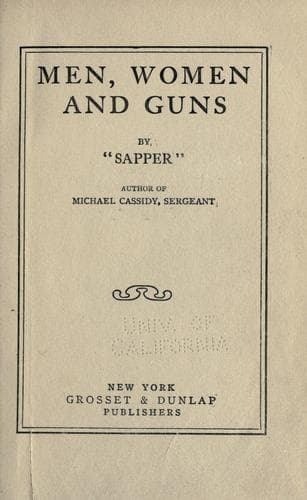
War stories, English; World War, 1914-1918 -- Fiction
"Hullo, old man! What sort of a time have you had?"
"Top-hole. How's yourself? Was that your memsahib at the station?"
"Yes. Dislike women at these partings as a general rule--but she's
wonderful."
"They're pulling the brigade out to rest, I hear."
"So I believe. Anyway, I hope they've buried that dead Hun just in front
of us. He was getting beyond a joke...."
He is back in the life over the water again; there is nothing
incongruous to him in his sequence of remarks; the time of his leave has
been too short for the contrast to strike him. In fact, the whirl of
gaiety in which he has passed his seven days seems more unreal than his
other life--than the dead German. And it is only when a man is wounded
and comes home to get fit, when he idles away the day in the home of his
fathers, with a rod or a gun to help him back to convalescence, when the
soothing balm of utter peace and contentment creeps slowly through his
veins, that he looks back on the past few months as a runner on a race
just over. He has given of his best; he is ready to give of his best
again; but at the moment he is exhausted; panting, but at rest For the
time the madness has left him; he is sane. But it is only for the
time....
* * * * *
He is able to think coherently; he is able to look on things in their
proper perspective. He knows. The bits in the kaleidoscope begin to
group coherently, to take definite form, and he views the picture from
the standpoint of a rational man. To him the leave-train contains no
illusions; the territory is not unknown. No longer does a dead Hun dwarf
his horizon to the exclusion of all else. He has looked on the thing
from close quarters; he has been mad with passion and shaking with
fright; he has been cold and wet, he has been hot and thirsty. Like a
blaze of tropical vegetation from which individual colours refuse to be
separated, so does the jumble of his life in Flanders strike him as he
looks back on it. Isolated occurrences seem unreal, hard to identify.
The little things which then meant so much now seem so paltry; the
things he hardly noticed now loom big. Above all, the grim absurdity of
the whole thing strikes him; civilisation has at last been defined....
He marvels that men can be such wonderful, such super-human fools; his
philosophy changes. He recalls grimly the particular night on which he
crept over a dirty ploughed field and scrambled into a shell-hole as he
saw the thin green streak of a German flare like a bar of light against
the blackness; then the burst--the ghostly light flooding the desolate
landscape--the crack of a solitary rifle away to his left. And as the
flare came slowly hissing down, a ball of fire, he saw the other
occupant of his hiding-place--a man's leg, just that, nothing more. And
he laughs; the thing is too absurd.
It is; it is absurd; it is monstrous, farcical. The realisation has come
to him; he is sane--for a time.
Public-domain text, read in full here on John Shaqi.
Reviews
Reviews
No reviews yet
Be the first to share your thoughts on this work.
Elsewhere in the archive
Join the Discussion
Join the discussion
Sign in to leave a comment or review.
Sign InorCreate an account