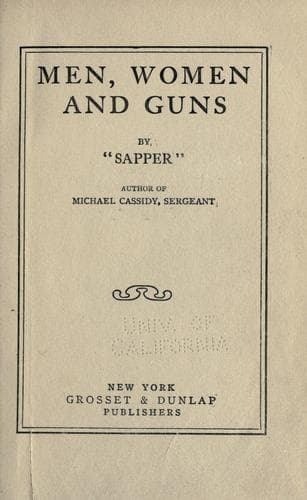
War stories, English; World War, 1914-1918 -- Fiction
Early in the morning of April 22nd the Germans launched at that part of
the French line which lay in front of the little villages of Elverdinge
and Brielen, a yellowish-green cloud of gas, which rolled slowly over
the intervening ground between the trenches, carried on its way by a
faint, steady breeze. I do not intend to describe the first use of that
infamous invention--it has been done too often before. But, for the
proper understanding of what follows, it is essential for me to go into
a few details. Utterly unprepared for what was to come, the French
divisions gazed for a short while spellbound at the strange phenomenon
they saw coming slowly towards them. Like some liquid the heavy-coloured
vapour poured relentlessly into the trenches, filled them, and passed
on. For a few seconds nothing happened; the sweet-smelling stuff merely
tickled their nostrils; they failed to realise the danger. Then, with
inconceivable rapidity, the gas worked, and blind panic spread.
Hundreds, after a dreadful fight for air, became unconscious and died
where they lay--a death of hideous torture, with the frothing bubbles
gurgling in their throats and the foul liquid welling up in their lungs.
With blackened faces and twisted limbs one by one they drowned--only
that which drowned them came from inside and not from out. Others,
staggering, falling, lurching on, and of their ignorance keeping pace
with the gas, went back. A hail of rifle-fire and shrapnel mowed them
down, and the line was broken. There was nothing on the British
left--their flank was up in the air. The north-east corner of the
salient round Ypres had been pierced. From in front of St. Julian, away
up north towards Boesienge, there was no one in front of the Germans.
It is not my intention to do more than mention the rushing up of the
cavalry corps and the Indians to fill the gap; the deathless story of
the Canadians who, surrounded and hemmed in, fought till they died
against overwhelming odds; the fate of the Northumbrian division--fresh
from home--who were rushed up in support, and the field behind Fortuin
where they were caught by shrapnel, and what was left. These things are
outside the scope of my story. Let us go back to the gap.
Hard on the heels of the French came the Germans advancing. For a mile
or so they pushed on, and why they stopped when they did is--as far as I
am concerned--one of life's little mysteries. Perhaps the utter success
of their gas surprised even them; perhaps they anticipated some trap;
perhaps the incredible heroism of the Canadians in hanging up the German
left caused their centre to push on too far and lose touch;
perhaps--but, why speculate? I don't know, though possibly those in High
Places may. The fact remains they did stop; their advantage was lost and
the situation was saved.
* * * * *
Public-domain text, read in full here on John Shaqi.
Reviews
Reviews
No reviews yet
Be the first to share your thoughts on this work.
Join the Discussion
Join the discussion
Sign in to leave a comment or review.
Sign InorCreate an account