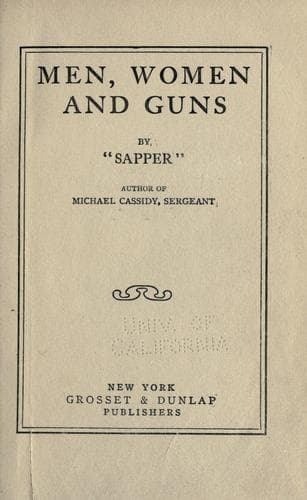
War stories, English; World War, 1914-1918 -- Fiction
The idea, as I say, was quite new to our friend. Even though that very
morning his colleague in the weigh-bill pastime had chucked it and
joined, even though he'd heard a foreman discussing who they were to put
in his place as "that young Meyrick was habsolutely 'opeless," it still
hadn't dawned on him that he might go too. But the recruiting sergeant
was a man of some knowledge; in his daily round he encountered many and
varied types. In two minutes he had fired the boy's imagination with a
glowing and partially true description of the glories of war and the
army, and supplied him with another set of dreams to fill his brain.
Wasting no time, he struck while the iron was hot, and in a few minutes
John Meyrick, sometime checker of weigh-bills, died, and No. 8469,
Private John Meyrick, came into being....
But though you change a man's vocation with the stroke of a pen, you do
not change his character. A dreamer he was in the beginning, and a
dreamer he remained to the end. And dreaming, as I have already pointed
out, was not a thing which commended itself to Company-Sergeant-Major
Hayton, who in due course became one of the chief arbiters of our
friend's destinies. True it was no longer coral islands--but such
details availed not with cook's mates and other busy movers in the
regimental hive. Where he'd got them from, Heaven knows, those tattered
volumes of Kipling; but their matchless spirit had caught his brain and
fired his soul, with the result--well, the first of them has been given.
There were more results to follow. Not three days after he was again
upon the mat for the same offence, only to say much the same as before.
"I do try, sir--I do try; but some'ow----"
And though in the bottom of his heart the officer believed him, though
in a very strange way he felt interested in him, there are limits and
there are rules. There comes a time, as he had said, when one can't
judge by motives, when one can only judge by results.
"You mustn't only try; you must succeed. Three days to barracks."
* * * * *
That night in mess the officer sat next to the Colonel. "It's the
thrusters, the martinets, the men of action who win the V.C.'s and
D.C.M.'s, my dear fellow," said his C.O., as he pushed along the wine.
"But it's the dreamers, the idealists who deserve them. They suffer so
much more."
And as Major Seymour poured himself out a glass of port, a face came
into his mind--the face of a stumpy, uncouth man with deep-set eyes. "I
wonder," he murmured--"I wonder."
* * * * *
Public-domain text, read in full here on John Shaqi.
Reviews
Reviews
No reviews yet
Be the first to share your thoughts on this work.
Join the Discussion
Join the discussion
Sign in to leave a comment or review.
Sign InorCreate an account