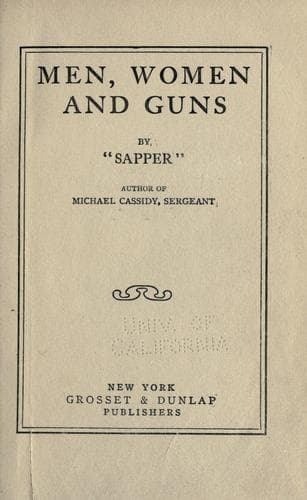
War stories, English; World War, 1914-1918 -- Fiction
And now we come to the last chapter--the chapter that you know. I'd been
back about two months when I first realised that there were stories
going round about me. There were whispers in the club; men avoided me;
women cut me. Then came the dreadful night when a man--half drunk--in
the club accused me of cowardice point-blank, and sneeringly contrasted
my previous reputation with my conduct on the _Astoria_. And I realised
that someone must have seen. I knocked that swine in the club down; but
the whispers grew. I knew it. Someone had seen, and it would be sheer
hypocrisy on my part to pretend that such a thing didn't matter. It
mattered everything: it ended me. The world--our world--judges deeds,
not motives; and even had I published at the time this document I am
sending to you, our world would have found me guilty. They would have
said what you would have said had you spoken the thoughts I saw in your
eyes that night I came to you. They would have said that a sudden wave
of cowardice had overwhelmed me, and that brought face to face with
death I had saved my own life at the expense of a woman's. Many would
have gone still further, and said that my black cowardice was rendered
blacker still by my hypocrisy in inventing such a story; that first to
kill the woman, and then to blacken her reputation as an excuse, showed
me as a thing unfit to live. I know the world.
Moreover, as far as I knew then--I am sure of it now--whoever it was who
saw my action, did not see who the woman was, and therefore the
publication of this document at that time would have involved Ginger,
for it would have been futile to publish it without names. Feeling as I
did that perhaps I should have sunk with her; feeling as I did that, for
good or evil, I had blasted Ginger's life, I simply couldn't do it. You
didn't believe in me, old chap; at the bottom of their hearts all my old
pals thought I'd shown the yellow streak; and I couldn't stick it. So I
went to the Colonel, and told him I was handing in my papers. He was in
his quarters, I remember, and started filling his pipe as I was
speaking.
"Why, Spud?" he asked, when I told him my intention.
And then I told him something of what I have written to you. I said it
to him in confidence, and when I'd finished he sat very silent.
"Good God!" he muttered at length. "Ginger's wife!"
"You believe me, Colonel?" I asked.
"Spud," he said, putting his hands on my shoulders, "that's a damn
rotten thing to ask me--after fifteen years. But it's the regiment." And
he fell to staring at the fire.
Aye, that was it. It was the regiment that mattered. For better or for
worse I had done what I had done, and it was my show. The Red Hussars
must not be made to suffer; and their reputation would have suffered
through me. Otherwise I'd have faced it out. As it was, I had to go; I
knew it. I'd come to the same decision myself.
Public-domain text, read in full here on John Shaqi.
Reviews
Reviews
No reviews yet
Be the first to share your thoughts on this work.
Join the Discussion
Join the discussion
Sign in to leave a comment or review.
Sign InorCreate an account