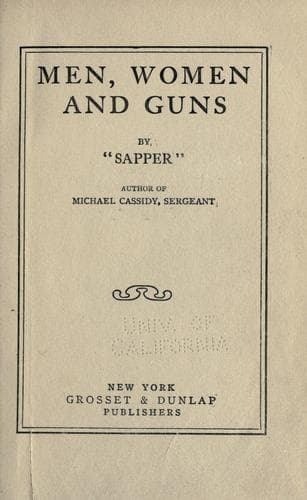
War stories, English; World War, 1914-1918 -- Fiction
* * * * *
It was on the Aisne I took it. Through that ghastly fourteen days we had
slogged dully south away from Mons, ever getting nearer Paris. Through
the choking dust, with the men staggering as they walked--some asleep,
some babbling, some cursing--but always marching, marching, marching;
digging at night, only to leave the trenches in two hours and march on
again; with ever and anon a battery of horse tearing past at a gallop,
with the drivers lolling drunkenly in their saddles, and the guns
jolting and swaying behind the straining, sweating horses, to come into
action on some ridge still further south, and try to check von Kluck's
hordes, if only for a little space. Every bridge in the hands of
anxious-faced sapper officers, prepared for demolition one and all, but
not to be blown up till all our troops were across. Ticklish work, for
should there be a fault, there is not much time to repair it.
But at last it was over, and we turned North. A few days later, in the
afternoon, my company crossed a pontoon bridge on the Aisne, and two
hours afterwards we dug ourselves in a mile and a half beyond it. The
next morning, as I was sitting in one of the trenches, there was a
sudden, blinding roar--and oblivion.
* * * * *
I will pass rapidly over the next six weeks--over my journey from the
clearing hospital to the base at Havre, of my voyage back to England in
a hospital ship, and my ultimate arrival at Drayton Hall, the Delawnays'
place in Somerset, where I had gone to convalesce.
During the time various fragments of iron were being picked from me and
the first shock of the concussion was wearing off, we had handed over
our trenches on the Aisne to the French, and moved north to Flanders.
Occasional scrawls came through from Jack and Jerry, but the people in
England who had any knowledge at all of the fighting and of what was
going on, grew to dread with an awful dread the sight of the
telegraph-boy, and it required an effort of will to look at those
prosaic casualty lists in the morning papers.
Then suddenly without warning, as such news always does, it came. The
War Office, in the shape of a whistling telegraph-boy, regretted to
inform Mr. Delawnay that his son, Lieutenant Jack Delawnay of the Royal
Downshire Regiment, had been killed in action.
Had it been possible during the terrible days after the news came, I
would have gone away, but I was still too weak to move; and I like to
think that, perhaps, my presence there was some comfort to them, as a
sort of connection through the regiment with their dead boy. After the
first numbing shock, the old man bore it grandly.
"He was all I had," he said to me one day as I lay in bed, "but I give
him gladly for his country's sake." He stood looking at the broad
fields. "All his," he muttered; "all would have been the dear lad's--and
now six inches of soil and a wooden cross, perhaps not that."
Public-domain text, read in full here on John Shaqi.
Reviews
Reviews
No reviews yet
Be the first to share your thoughts on this work.
Join the Discussion
Join the discussion
Sign in to leave a comment or review.
Sign InorCreate an account