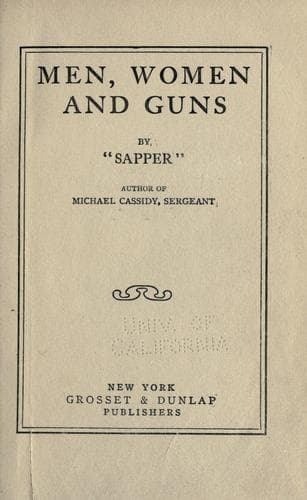
War stories, English; World War, 1914-1918 -- Fiction
"You'll see, old man, in time," he answered. "First and foremost, get
back to the regiment, arm or no arm. I would not have come home, but I
had to see her once more."
"You talk as if it was the end." I looked at him squarely.
"It is," he answered. "It's easy out there."
"Your mind is made up?"
"Absolutely." He gave a short laugh. "Good-bye, old friend. Ease it to
her as well as you can. Say I'm unstrung by the trenches, anything you
like; but don't let her guess the truth."
For a long minute he held my hand. Then he turned away. He walked to the
mantelpiece, and there was a photograph of her there. For a long time he
looked at it, and it seemed to me he whispered something. A sudden
dimness blinded my eyes, and when I looked again he had gone--through
the window into the night.
* * * * *
I did not see Pat until I left Drayton Hall after that ghastly night,
save only once or twice with her mother in the room.
But an hour before I left she came to me, and her face was that of a
woman who has passed through the fires.
"Tell me, Winkle, shall I ever see him again? You know what I mean."
"You will never see him again, Pat," and the look in her eyes made me
choke.
"Will you tell me what it was he told you before he went through the
window? You see, I was in the hall waiting for him," and she smiled
wearily.
"I can't, Pat dear; I promised him," I muttered. "But it was nothing
disgraceful."
"Disgraceful!" she cried proudly. "Jerry, and anything disgraceful. Oh,
my God! Winkle dear," and she broke down utterly, "do you remember the
waltz they were playing that day--'Destiny'?"
And then I went. Whether that wonderful woman's intuition has told her
something of what happened, I know not. But yesterday morning I got a
letter from the Colonel saying that Jerry had chucked his life away,
saving a wounded man. And this morning she will have seen it in the
papers.
God help you, Pat, my dear.
CHAPTER V
JIM BRENT'S V.C.
If you pass through the Menin-Gate at Ypres, and walk up the slight rise
that lies on the other side of the moat, you will come to the parting of
the ways. You will at the same time come to a spot of unprepossessing
aspect, whose chief claim to notoriety lies in its shell-holes and
broken-down houses. If you keep straight on you will in time come to the
little village of Potige; if you turn to the right you will eventually
arrive at Hooge. In either case you will wish you hadn't.
Before the war these two roads--which join about two hundred yards east
of the rampart walls of Ypres--were adorned with a fair number of
houses. They were of that stucco type which one frequently sees in
England spreading out along the roads that lead to a largish town.
Generally there is one of unusually revolting aspect that stands proudly
by itself a hundred yards or so from the common herd and enclosed in a
stuccoesque wall. And there my knowledge of the type in England ends.
Public-domain text, read in full here on John Shaqi.
Reviews
Reviews
No reviews yet
Be the first to share your thoughts on this work.
Join the Discussion
Join the discussion
Sign in to leave a comment or review.
Sign InorCreate an account